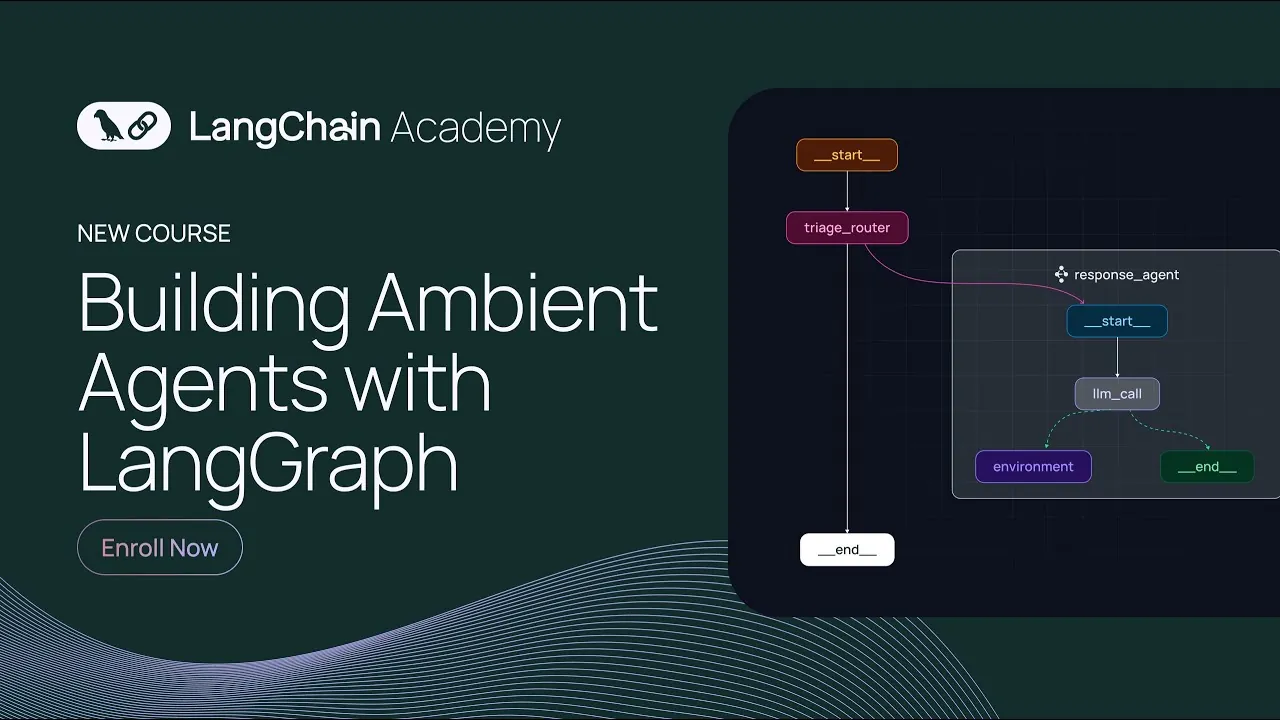
What if your workflows could manage themselves—responding to emails, reallocating tasks, or predicting inventory needs—all without you lifting a finger? Enter the world of ambient agents, a new evolution in artificial intelligence. Unlike traditional chatbots that wait for your command, these agents operate independently, triggered by real-time events like Slack notifications or GitHub updates. Imagine an agent that not only monitors your project deadlines but also reassigns tasks and notifies your team when something slips through the cracks. This isn’t just automation; it’s a shift toward systems that think, adapt, and act autonomously, freeing you to focus on what truly matters.
LangChain explain how the LangGraph framework enables developers to build these next-generation agents. From handling complex, long-running workflows to integrating seamlessly into dynamic environments, LangGraph provides the tools to create scalable and adaptable solutions. You’ll discover how event streams act as the lifeblood of these agents, allowing them to respond to changes in real time, and how features like memory capabilities and human-in-the-loop mechanisms ensure both precision and accountability. Whether you’re looking to streamline operations or transform your industry, the possibilities are as exciting as they are fantastic. What role could ambient agents play in reshaping your approach to work?
Overview of Ambient Agents
TL;DR Key Takeaways :
- Ambient agents autonomously manage complex, long-running workflows triggered by event streams (e.g., Slack notifications, GitHub updates) without requiring constant user input, enhancing operational efficiency.
- Event streams are crucial for real-time responsiveness, allowing agents to adapt dynamically, automate tasks, and reduce human error in time-sensitive processes.
- The LangGraph framework supports scalable and adaptable ambient agent development, offering features like persistence, scalable infrastructure, and seamless integration for managing diverse workflows.
- Langsmith tools optimize agent performance by monitoring behavior, refining decision-making through prompt engineering, and evaluating effectiveness using predefined metrics.
- Ambient agents have versatile applications across industries, including email management, supply chain optimization, and customer support, driving efficiency and scalability while reducing manual effort.
Understanding Ambient Agents
Ambient agents are distinct from chat agents in both purpose and functionality. While chat agents are designed to assist conversations, ambient agents are task-oriented systems that autonomously manage workflows. For example, an ambient agent can monitor incoming emails, categorize them, and respond based on predefined rules—all without requiring your intervention. These agents thrive in event-driven environments where tasks demand sustained attention over time. Their ability to scale across multiple workflows makes them an invaluable tool for businesses seeking to streamline operations and reduce manual effort.
By automating repetitive tasks and maintaining continuous workflow management, ambient agents free up human resources for higher-value activities. Their utility extends beyond simple automation, as they are capable of adapting to dynamic environments and handling complex scenarios with minimal oversight.
The Role of Event Streams in Ambient Agents
Event streams serve as the backbone of ambient agent functionality. These streams, which include notifications from tools like Slack, updates from project management platforms, or changes in system logs, act as triggers for agent actions. By processing event data in real-time, ambient agents can initiate workflows such as assigning tasks, updating records, or generating reports.
This real-time responsiveness ensures that your agents remain proactive, adapting to the evolving needs of your operations. For instance, an agent monitoring a project management platform can automatically reassign tasks when deadlines are missed or notify team members of critical updates. This capability not only enhances efficiency but also reduces the risk of human error in time-sensitive processes.
Building Ambient Agents with LangGraph

Gain further expertise in AI agents by checking out these recommendations.
Balancing Autonomy and Human Oversight
While ambient agents are designed for high levels of autonomy, incorporating human oversight is essential for maintaining accountability and refining performance. Human-in-the-loop mechanisms allow you to intervene at critical moments, such as approving sensitive actions, refining outputs, or addressing ambiguities. For example, when deploying an agent to manage customer support workflows, you can review its responses to ensure they align with your organization’s standards.
This collaborative approach enhances the agent’s effectiveness over time. By periodically reviewing and adjusting the agent’s decision-making processes, you can ensure that it remains aligned with your goals and continues to deliver reliable results. Additionally, this balance fosters trust in the system, as users can rely on the agent to handle tasks while retaining the ability to intervene when necessary.
Core Features of the LangGraph Framework
The LangGraph framework is specifically designed to support the development and orchestration of ambient agents. Its robust set of features enables developers to create agents that are both scalable and adaptable to complex, real-world scenarios. Key features include:
- Persistence Layer: Allows agents to revisit and modify their states, making sure continuity in long-running workflows.
- Scalable Infrastructure: Handles bursty workloads, making it suitable for applications requiring high availability and reliability.
- Seamless Integration: Supports the deployment of single agents or networks of agents, making sure smooth operation at scale.
These features make LangGraph an ideal choice for building ambient agents capable of managing diverse and demanding workflows.
Optimizing Agent Performance with Langsmith
To maximize the effectiveness of your ambient agents, the Langsmith platform provides a suite of tools for observability and evaluation. These tools enable you to:
- Monitor Agent Behavior: Identify inefficiencies or bottlenecks in real-time.
- Refine Decision-Making: Use prompt engineering to improve the accuracy and relevance of agent actions.
- Evaluate Effectiveness: Assess agent performance using predefined metrics to ensure alignment with organizational objectives.
By using Langsmith, you can continuously improve your agents, making sure they remain adaptable to changing requirements and aligned with your operational goals.
Memory Capabilities for Contextual Adaptation
Memory capabilities are a critical component of ambient agents, allowing them to retain and use contextual information. This allows agents to adapt to evolving requirements and provide more accurate responses. For instance, an agent managing customer support tickets can learn from past interactions to deliver personalized solutions. Similarly, an agent overseeing supply chain workflows can analyze historical data to predict inventory needs and optimize restocking schedules.
This adaptability not only enhances user satisfaction but also reduces the need for manual intervention. Over time, the agent becomes more efficient, capable of handling increasingly complex tasks with minimal oversight.
Steps to Build and Deploy Ambient Agents
Developing an ambient agent involves a structured approach to ensure effectiveness and scalability. Key steps include:
- Identify a Use Case: Select a specific task or workflow, such as email management, project tracking, or customer support.
- Design Workflows: Use the LangGraph framework to map out workflows and integrate relevant event streams.
- Incorporate Human Oversight: Implement mechanisms for human intervention to maintain accountability and refine performance.
- Deploy at Scale: Use LangGraph’s scalable infrastructure to meet the demands of your application.
- Monitor and Improve: Use Langsmith tools to evaluate and enhance the agent’s behavior over time.
This methodical process ensures that your agents are both effective and adaptable, capable of meeting the unique challenges of your operational environment.
Applications of Ambient Agents Across Industries
Ambient agents built with LangGraph have the potential to transform operations across various industries. By automating routine tasks and managing complex workflows, these agents drive efficiency and scalability in areas such as:
- Email Management: Automatically categorize and respond to emails based on predefined rules, reducing the burden of manual sorting.
- Supply Chain Optimization: Monitor inventory levels, predict demand, and trigger restocking workflows to ensure seamless operations.
- Customer Support: Provide personalized responses by learning from past interactions, improving customer satisfaction and loyalty.
By implementing ambient agents, organizations can focus on strategic priorities while achieving greater operational efficiency and scalability.
Media Credit: LangChain
Filed Under: AI, Guides
Latest Geeky Gadgets Deals
Disclosure: Some of our articles include affiliate links. If you buy something through one of these links, Geeky Gadgets may earn an affiliate commission. Learn about our Disclosure Policy.
Credit: Source link