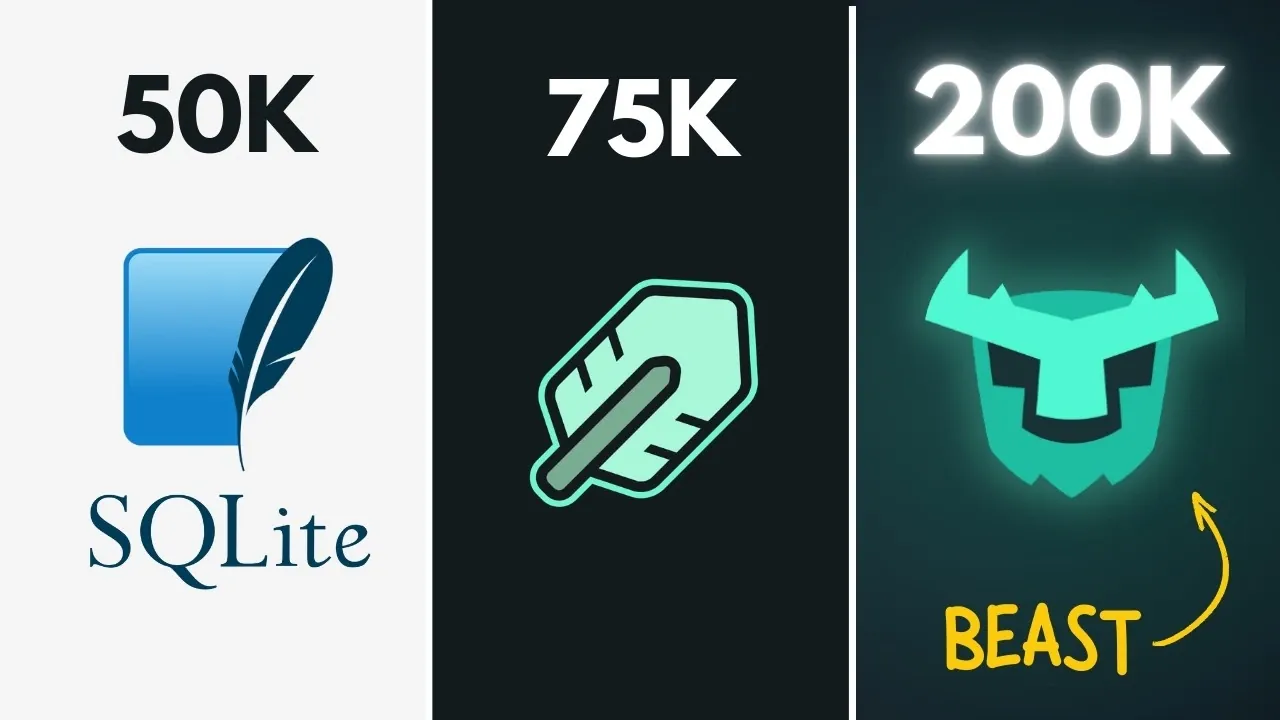
What if the database you rely on could handle writes four times faster without sacrificing simplicity or reliability? For years, SQLite’s single-writer limitation has been both its strength and Achilles’ heel, making sure data integrity but creating bottlenecks in high-demand scenarios like real-time analytics or multiplayer gaming. Turso, however, has rewritten the rules. By reimagining SQLite in Rust and integrating innovative techniques like Multi-Version Concurrency Control (MVCC), Turso has achieved a breakthrough: a 4x improvement in write performance. This innovation doesn’t just tweak SQLite’s capabilities, it redefines what lightweight databases can achieve in environments that demand speed and concurrency.
In this exploration, Better Stack uncover how Turso tackled SQLite’s most significant constraint and what this means for developers navigating the trade-offs between simplicity and scalability. From the fantastic power of MVCC to the challenges of memory consumption and experimental design, this deep dive will reveal the technical ingenuity behind Turso’s rewrite. Whether you’re a database enthusiast or a developer seeking better performance for demanding applications, this overview will leave you questioning the limits of what lightweight databases can accomplish. After all, when simplicity meets speed, the possibilities are anything but ordinary.
Turso’s SQLite Rewrite
TL;DR Key Takeaways :
- Turso has rewritten SQLite in Rust, introducing Multi-Version Concurrency Control (MVCC) to enable multiple concurrent writes, addressing SQLite’s single-writer limitation.
- The rewrite delivers a fourfold improvement in write performance, achieving nearly 200,000 writes per second in specific scenarios, making it suitable for high-demand applications like real-time analytics and multiplayer gaming.
- Key features include asynchronous I/O for better concurrency, browser compatibility for modern web development, and vector indexing for optimized query performance on large datasets.
- Challenges include increased memory consumption due to storing full row copies in memory and scalability constraints on multi-core systems, limiting its use in certain environments.
- Turso builds on LibSQL, a community-driven SQLite fork, but remains experimental and not production-ready, requiring developers to carefully evaluate its trade-offs and suitability for specific use cases.
SQLite’s Write Limitation and Its Impact
SQLite is widely recognized for its simplicity, reliability, and versatility, making it a popular choice for embedded systems, mobile applications, and lightweight databases. However, its architecture imposes a critical limitation: only one write operation can occur at a time. This design prioritizes data integrity but creates a bottleneck in scenarios requiring high write throughput.
In applications such as financial trading platforms, real-time analytics, or multiplayer online games, the need for rapid and concurrent data writes is paramount. SQLite’s single-writer constraint often forces developers to either adopt more complex database systems or implement intricate workarounds to meet performance demands. These limitations have historically restricted SQLite’s use in high-performance environments.
Turso’s Approach: Rewriting SQLite in Rust
To overcome SQLite’s inherent write bottleneck, Turso undertook a complete rewrite of the database in Rust, a programming language renowned for its memory safety and performance. This rewrite introduced several fantastic features that significantly enhance SQLite’s capabilities:
- Multi-Version Concurrency Control (MVCC): MVCC enables multiple concurrent write operations by maintaining temporary versions of rows in memory. This eliminates the need for traditional locking mechanisms, which typically block concurrent writes.
- Asynchronous I/O: By using asynchronous input/output operations, Turso improves performance in environments with high concurrency, making sure faster data processing.
- Browser Compatibility: The new architecture extends SQLite’s usability to browser-based applications, making it more relevant for modern web development.
- Vector Indexing: Advanced indexing techniques enhance query performance, particularly for large or complex datasets, by optimizing data retrieval processes.
The implementation of MVCC, inspired by Microsoft’s Hekaton, is central to Turso’s performance improvements. By tracking multiple row versions in memory, it ensures that concurrent writes do not overwrite each other, maintaining both speed and data consistency. This approach eliminates the traditional trade-off between concurrency and reliability.
How Turso Made SQLite 4x Faster at Writes

Learn more about AI coding by reading our previous articles, guides and features :
Performance Gains and Practical Implications
Turso’s enhancements have delivered impressive results, with the database now capable of handling nearly 200,000 writes per second in specific scenarios, an improvement of four times over traditional SQLite. This performance boost makes Turso a compelling choice for applications requiring rapid data ingestion, real-time processing, or high-frequency updates.
The MVCC mechanism achieves this by creating temporary versions of rows during write operations. These versions are later garbage collected, making sure efficient memory usage over time. This approach not only enhances write throughput but also preserves SQLite’s core attributes of simplicity and reliability, making it accessible to developers familiar with the original database.
Challenges and Trade-Offs
Despite its significant advancements, Turso’s solution introduces new challenges that developers must carefully evaluate. The current MVCC implementation stores full copies of rows in memory, which can lead to increased memory consumption, particularly for tables with frequent updates. This trade-off may limit its applicability in memory-constrained environments.
Additionally, the use of a reader-locked vector for managing row versions imposes scalability constraints on multi-core systems. This design choice limits the database’s ability to fully use modern hardware, especially in environments with high levels of parallelism.
Another important consideration is that Turso’s rewrite remains experimental and is not yet production-ready. Developers exploring this solution must weigh its performance benefits against its current limitations and the risks associated with adopting an experimental technology.
LibSQL’s Role in Turso’s Evolution
Turso’s advancements build upon LibSQL, a community-driven fork of SQLite designed to enable open contributions and introduce features like server support and replication. While LibSQL expanded SQLite’s functionality, it retained many of the architectural constraints that limited its scalability.
By rewriting LibSQL in Rust and integrating advanced features such as MVCC, Turso has addressed these limitations, creating a more scalable and performant database solution. This evolution represents a significant step forward in the development of SQLite-based systems, offering a glimpse into the future of lightweight, high-performance databases.
Future Potential and Considerations
Turso’s innovative rewrite of SQLite demonstrates the potential for significant performance improvements in lightweight databases. By addressing SQLite’s single-writer limitation, Turso has opened new possibilities for its use in demanding applications such as financial systems, real-time analytics, and multiplayer gaming.
However, its experimental nature and current limitations highlight the need for further refinement before it can be widely adopted in production environments. Developers considering Turso must carefully assess its suitability for their specific use cases, balancing its performance benefits against its memory requirements and scalability constraints.
As Turso continues to evolve, it represents a promising advancement in the field of database technology, offering a pathway to more efficient and versatile solutions for modern application development.
Media Credit: Better Stack
Filed Under: AI, Guides
Latest Geeky Gadgets Deals
Disclosure: Some of our articles include affiliate links. If you buy something through one of these links, Geeky Gadgets may earn an affiliate commission. Learn about our Disclosure Policy.
Credit: Source link