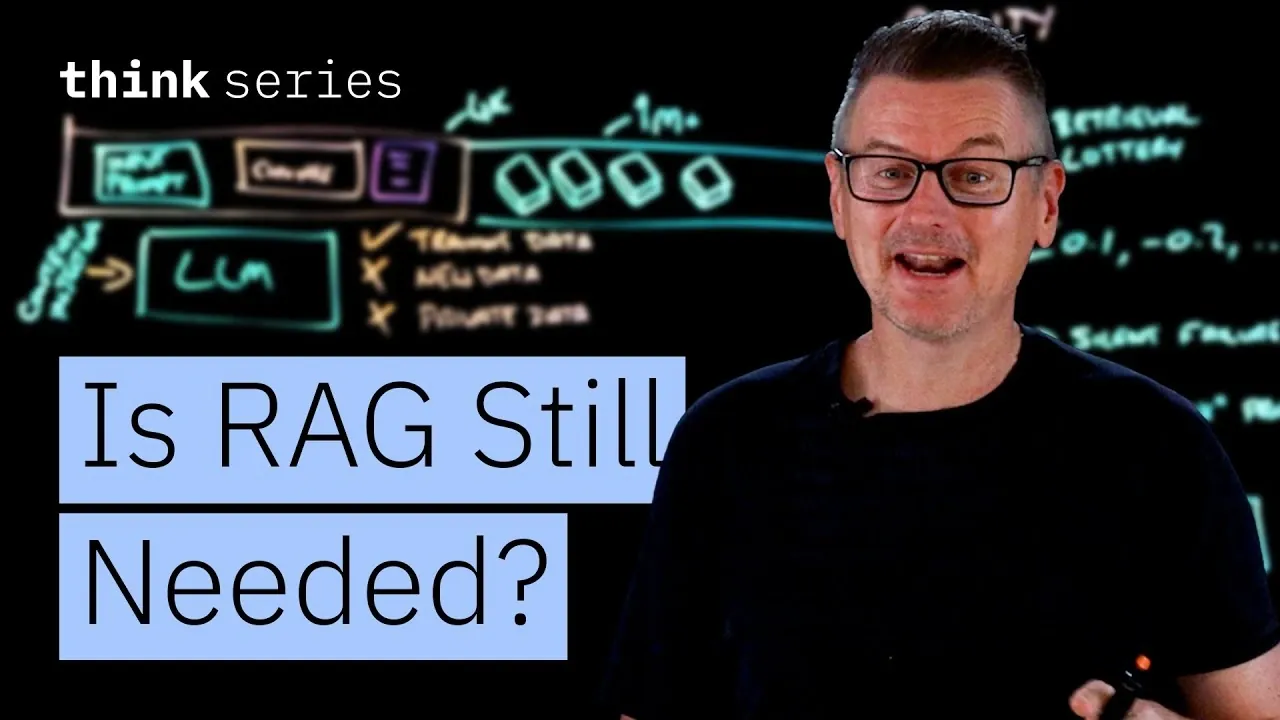
Large Language Models (LLMs) have transformed natural language processing, but their limitations, such as fixed training data and lack of real-time updates, pose challenges for certain applications. IBM Technology explores two prominent strategies for addressing these gaps: Retrieval-Augmented Generation (RAG) and long context. RAG integrates external data through embedding models and vector databases, making it ideal for dynamic datasets like enterprise knowledge bases. In contrast, long context uses expanded token capacities to process entire datasets directly, offering a streamlined approach for bounded tasks such as contract analysis or document summarization.
This explainer by IBM provides a clear breakdown of when to choose RAG or long context based on your specific needs. You’ll learn how RAG’s retrieval mechanisms can handle evolving datasets efficiently while minimizing computational costs and why long context might be better suited for tasks requiring global reasoning across static datasets. By the end, you’ll have a practical understanding of how to align these approaches with your operational priorities.
RAG vs Long Context
TL;DR Key Takeaways :
- Large Language Models (LLMs) have advanced natural language processing but are limited by their training cutoff date and lack of access to real-time or private data.
- Retrieval-Augmented Generation (RAG) integrates external data into LLMs using embedding models and vector databases, making it ideal for dynamic, frequently updated datasets.
- Long context uses expanded token capacities to process entire datasets directly, eliminating the need for external retrieval mechanisms and simplifying system architecture.
- RAG is best suited for large, dynamic datasets requiring efficiency and scalability, while long context is optimal for bounded datasets needing comprehensive reasoning and simplicity.
- Key factors in choosing between RAG and long context include infrastructure complexity, computational efficiency, scalability and accuracy, depending on the specific use case and dataset characteristics.
What is Retrieval-Augmented Generation (RAG)?
Retrieval-Augmented Generation (RAG) combines embedding models and vector databases to retrieve and integrate relevant external data into LLMs. This approach is particularly effective for managing large, dynamic datasets that are frequently updated. By converting text into numerical embeddings, RAG enables efficient similarity searches, making sure that only the most relevant information is retrieved and processed by the LLM.
- Advantages:
- Efficiency: RAG is highly efficient for dynamic datasets, as it avoids the need to repeatedly process static data.
- Real-Time Applications: It is ideal for scenarios like enterprise knowledge bases or real-time data retrieval, where up-to-date information is critical.
- Reduced Computational Overhead: By focusing only on relevant data, RAG minimizes unnecessary computational costs.
- Challenges:
- Infrastructure Complexity: RAG requires a sophisticated setup, including embedding models, vector databases and retrieval pipelines.
- Risk of Silent Failures: Irrelevant or incomplete data may be retrieved, potentially reducing the accuracy of the output.
- Dataset Gaps: RAG struggles to identify missing information in datasets, which can lead to incomplete reasoning.
What is Long Context?
Long context uses the expanding token capacities of modern LLMs to input entire documents or large datasets directly into the model’s context window. This approach eliminates the need for external retrieval mechanisms, simplifying the overall system architecture.
- Advantages:
- Comprehensive Reasoning: Long context enables the model to analyze entire datasets, making it suitable for tasks like contract analysis or book summarization.
- Elimination of Retrieval Errors: By processing all relevant data simultaneously, long context avoids errors associated with external retrieval.
- Simplified Architecture: The absence of retrieval components reduces system complexity.
- Challenges:
- High Computational Costs: Processing large datasets for every query can be resource-intensive.
- Attention Dilution: As the context window grows, the model’s attention mechanisms may become less focused, potentially reducing output accuracy.
- Scalability Limitations: Long context is constrained by the model’s token capacity, making it less suitable for vast datasets.
Here are additional guides from our expansive article library that you may find useful on Retrieval-Augmented Generation.
RAG vs Long Context: How to Decide
Determining whether to use RAG or long context depends on the characteristics of your dataset and the specific demands of your task. Below is a comparison to help guide your decision:
- Use Long Context When:
- Your dataset is bounded and requires global reasoning, such as analyzing legal contracts or summarizing books.
- You want to avoid retrieval errors and ensure all relevant data is processed simultaneously.
- Simplicity in system architecture is a priority and external retrieval mechanisms are unnecessary.
- Use RAG When:
- You are working with large, dynamic datasets that are frequently updated, such as enterprise knowledge bases or customer support systems.
- Efficiency and scalability are critical, as RAG retrieves only the most relevant data for processing.
- You need to minimize computational costs by avoiding repeated analysis of static data.
Key Factors to Consider
Selecting the most suitable approach requires a careful evaluation of several critical factors:
- Infrastructure Complexity: RAG demands a more intricate setup, including embedding models and retrieval pipelines, while long context simplifies architecture by eliminating external retrieval components.
- Computational Efficiency: Long context can be resource-intensive due to the need to process large datasets for every query. In contrast, RAG optimizes efficiency by focusing only on the necessary data.
- Scalability: RAG is better suited for large or continuously evolving datasets, whereas long context is limited by the model’s token capacity and may struggle with vast datasets.
- Accuracy and Focus: Long context avoids retrieval errors by processing all relevant data simultaneously, but RAG ensures targeted retrieval of the most pertinent information, which can enhance precision.
Making the Right Choice
The decision between RAG and long context ultimately depends on your specific use case and priorities. If your task involves bounded datasets that require comprehensive reasoning, long context may be the optimal choice. On the other hand, for dynamic, large-scale datasets, RAG offers the efficiency and scalability needed to deliver accurate results. By thoroughly assessing your requirements and weighing the trade-offs of each approach, you can select the method that best aligns with your goals and operational needs.
Media Credit: IBM Technology
Filed Under: AI, Guides
Disclosure: Some of our articles include affiliate links. If you buy something through one of these links, Geeky Gadgets may earn an affiliate commission. Learn about our Disclosure Policy.
Credit: Source link