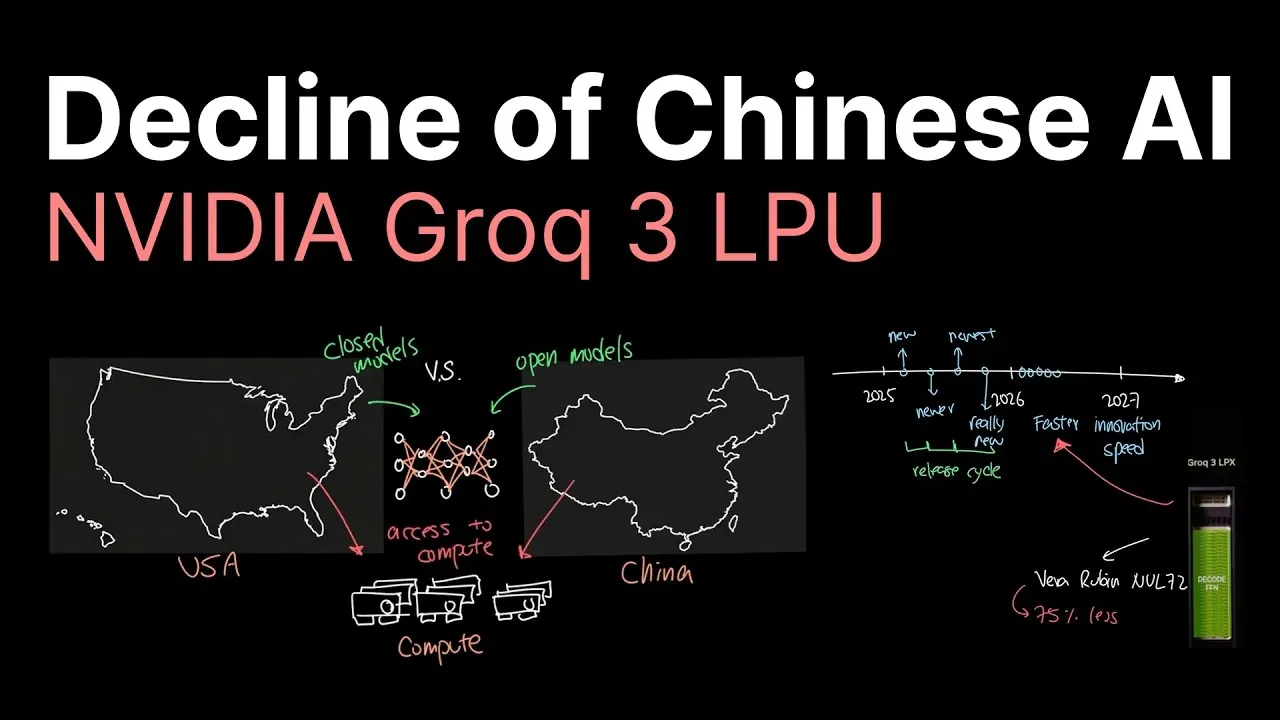
Chinese AI development is facing significant hurdles, particularly in comparison to advancements in the United States. According to Caleb Writes Code, one major factor contributing to this disparity is the limited access Chinese labs have to state-of-the-art computing hardware, such as NVIDIA’s Gro 3 LPU and VR Rubin NVL72 modules. These systems are critical for achieving efficiency and scalability, yet their restricted availability has left Chinese labs dependent on older, less capable technology. This technological gap not only hampers innovation but also increases operational costs, further widening the divide between Chinese and U.S. AI research.
Gain insight into the economic and technological challenges confronting Chinese AI labs, including the impact of hardware limitations on research progress. Explore the strategic advantages that advanced hardware provides to U.S.-based labs, allowing faster development and cost efficiency. Understand the broader implications of these trends for global AI competition and the potential long-term effects on innovation across the field.
U.S. Dominance in AI
TL;DR Key Takeaways :
- U.S. AI labs are dominating the global AI landscape due to superior access to innovative hardware, such as NVIDIA’s advanced compute modules, while Chinese labs struggle with outdated technology.
- The hardware gap is reshaping the efficiency, innovation speed and cost-effectiveness of AI development, giving U.S. labs a decisive edge in the global AI race.
- Closed U.S. labs, like OpenAI, use advanced hardware and proprietary algorithms to achieve breakthroughs in efficiency and scalability, further consolidating their market dominance.
- Chinese AI labs face significant economic and technological disadvantages, with limited access to state-of-the-art resources, leading to slower innovation and higher operational costs.
- The global AI market is trending toward consolidation, with dominant players capturing the majority of market share, while Chinese labs risk becoming marginalized without bold strategies and investments in advanced technology.
The implications of this divide extend beyond the immediate technological realm. They influence the broader economic and strategic dynamics of the AI industry, where access to advanced resources increasingly determines leadership and innovation. The growing gap underscores the critical role of technological infrastructure in shaping the future of AI development and market dominance.
Market Dynamics: U.S. Labs Take the Lead
The AI market is consolidating around a few dominant players, with U.S.-based closed labs emerging as clear leaders. Companies such as OpenAI and Miniax are using their access to advanced hardware and proprietary models to achieve unparalleled performance. These closed labs excel in areas like token efficiency and throughput optimization, giving them a decisive edge over competitors, particularly open source models.
While open source AI remains relevant for specific localized and small-scale applications, its influence is diminishing in the face of high-performance, closed systems. Chinese labs, once considered formidable competitors, are now falling behind. A major factor contributing to this shift is their inability to secure access to state-of-the-art compute modules, which are essential for training and deploying large-scale AI models. This lack of access highlights the growing importance of technological resources in determining market leadership.
The dominance of U.S. labs is further reinforced by their ability to integrate advanced hardware with proprietary algorithms, creating a feedback loop of innovation and efficiency. This dynamic leaves Chinese labs at a disadvantage, as they struggle to compete with outdated technology and limited resources.
Compute Access: The Core of the Divide
At the heart of the widening gap between U.S. and Chinese AI labs lies unequal access to advanced computing resources. U.S. hyperscalers, including major cloud providers, benefit from early access to NVIDIA’s latest hardware innovations, such as the Gro 3 LPU and VR Rubin NVL72. These modules deliver unprecedented performance, allowing faster innovation cycles and significantly reducing training costs.
In contrast, Chinese AI labs face restrictions and delays in acquiring similar technology. This forces them to rely on older, less efficient hardware, which severely limits their ability to scale and innovate. For instance, NVIDIA’s Gro 3 LPU offers 35 times lower cost per token and 50 times higher throughput per megawatt compared to outdated systems. Without access to such advancements, Chinese labs are at a severe disadvantage, both economically and technologically.
The consequences of this hardware gap are far-reaching. U.S. labs are able to accelerate their development timelines, reduce operational costs and achieve breakthroughs that are out of reach for their Chinese counterparts. This disparity not only affects the competitiveness of individual labs but also has broader implications for the global AI ecosystem.

Become an expert in NVIDIA with the help of our in-depth articles and helpful guides.
Closed Labs: Using Technological Superiority
U.S.-based closed labs have capitalized on their access to advanced hardware to push the boundaries of AI development. NVIDIA’s Gro 3 LPU and similar modules have enabled these labs to achieve significant advancements in efficiency, scalability and cost reduction. These advantages are not incremental, they represent a fundamental shift in the economics of AI development.
The ability to process vast amounts of data with lower energy consumption allows closed labs to train models faster and at a fraction of the cost. This efficiency is critical in an industry where training expenses can reach millions of dollars. For example, the Gro 3 LPU’s superior performance enables U.S. labs to handle complex tasks with unprecedented speed and precision, further solidifying their dominance.
In contrast, Chinese labs, constrained by outdated technology, face higher operational costs and slower development timelines. These limitations not only hinder their ability to compete but also exacerbate the economic pressures they face in an increasingly consolidated market. The technological gap between U.S. and Chinese labs is becoming a defining factor in the global AI race, with profound implications for the future of the industry.
Economic and Competitive Consequences
The economic implications of the hardware gap are profound and far-reaching. U.S. labs are able to maintain a competitive edge by operating more efficiently and at lower costs, while Chinese labs struggle to justify the high expenses associated with training and deploying models using outdated systems. This disparity is particularly significant in an industry where capital-intensive investments are the norm.
Market consolidation is an increasingly likely outcome. As dominant players solidify their positions, smaller and less competitive labs may be forced to exit the market. This trend is especially concerning for Chinese labs, which are already grappling with limited resources and increasing economic pressures. The result could be a global AI landscape dominated by a handful of well-resourced players, leaving others to focus on niche or localized applications.
The broader economic consequences of this consolidation are also worth noting. A concentrated AI market could limit innovation and reduce the diversity of solutions available to address complex global challenges. This underscores the importance of addressing the hardware gap to ensure a more balanced and competitive AI ecosystem.
Future Trends: Consolidation and Localization
The global AI market is poised for further consolidation, with a small number of dominant labs expected to drive innovation and capture the majority of market share. Closed labs with superior resources and efficiency are likely to lead this trend, while open source models may continue to play a role in localized and smaller-scale applications.
For Chinese AI labs, the future remains uncertain. While global demand for AI solutions is expected to grow, challenges related to hardware access and funding may limit their ability to compete on a global scale. Without significant changes, such as strategic investments or partnerships to secure advanced resources, their role in the AI ecosystem may become increasingly marginal.
The path forward for Chinese labs will require bold strategies and innovative approaches. Investments in domestic hardware development, collaborations with international partners and a focus on niche markets could help mitigate some of the challenges they face. However, the road ahead is fraught with obstacles and the outcome remains uncertain.
The decline of Chinese AI labs highlights the critical importance of access to advanced computing resources in shaping the future of artificial intelligence. As U.S. hyperscalers and closed labs continue to dominate, the gap between leading and lagging players is likely to widen. For Chinese labs, overcoming these challenges will require bold strategies, including investments in innovative technology and collaborations to secure essential resources. Without such efforts, their ability to remain competitive in an increasingly consolidated market will remain in jeopardy.
Media Credit: Caleb Writes Code
Filed Under: AI, Top News
Disclosure: Some of our articles include affiliate links. If you buy something through one of these links, Geeky Gadgets may earn an affiliate commission. Learn about our Disclosure Policy.
Credit: Source link