
WORDS: Supplied PHOTOGRAPHY Supplied
Most people assume ADAS-equipped vehicles simplify accident claims. They do not. When a Lane-Keep Assist system silently corrects a steering input two seconds before impact, or an Automatic Emergency Braking module fails to engage because rain obscures a sensor, the claim stops being a straightforward negligence dispute and becomes a multi-party liability puzzle.
Insurers, manufacturers, and attorneys each have competing interests in how that data is interpreted, and the driver who trusted the technology is often the last to understand what the vehicle recorded. Luxury manufacturers market these systems aggressively. Buyers pay premium prices expecting a safety net. What they rarely receive is a clear explanation of what that net cannot catch.
ADAS Data Layers Add Defendants, Not Just Evidence
Every modern luxury vehicle equipped with SAE Level 2 systems records telemetry in real time. The Event Data Recorder (EDR) captures pre-crash speed, brake activation, throttle position, and steering input under federal standards codified at 49 CFR Part 563. That data is neutral, but it is not simple.
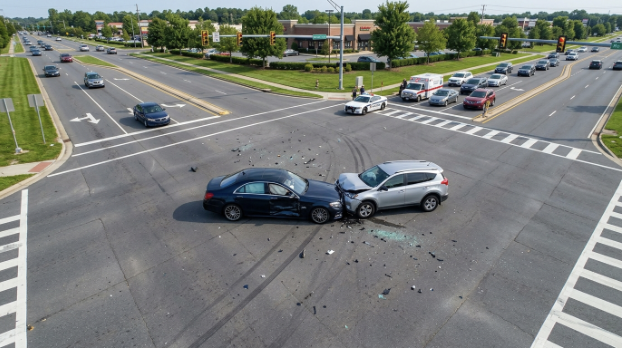
A single accident involving an ADAS-equipped vehicle can now implicate the driver, the manufacturer, and potentially a software vendor. Courts determine fault differently when a lane-departure warning failed to alert, when adaptive cruise control held speed through a construction zone, or when a forward collision system braked too hard and caused a rear-end collision.
A Miami jury awarded more than $329 million in damages after finding Tesla’s Autopilot system defective in a fatal 2019 crash. Product liability claims now sit alongside ordinary negligence theories in ADAS cases.
How ADAS Sensor Failures Blur the Duty of Care
The duty of care analysis becomes genuinely difficult when a sensor failed first. ADAS performance can degrade due to sensor deterioration, misalignment, or adverse environmental conditions. Separate real-world effectiveness data covering 7.7 million crash-involved vehicles (model years 2015–2023) measure system crash-reduction benefits, not progressive degradation. A camera obscured by frost, a radar module misaligned after a minor parking lot strike, or a software version that quietly degraded lane-detection accuracy can all undercut the driver’s reasonable expectation that the system would perform as designed.
When sensor failure precedes the crash, the driver’s comparative fault may drop substantially. But that argument requires testimony from an accident reconstruction specialist familiar with ADAS architecture, and it requires preserving the vehicle before the insurer, the defendant, or a salvage yard destroys the evidence. Claimants have days, not weeks.
Brent Stewart, a Rock Hill car accident lawyer, recognized in Best Lawyers: Ones to Watch® in America, National Trial Lawyers Top 100 Trial Lawyers, and founding litigator behind stewartlawoffices.net, a winner-firm of the “Best of York County” Awards sweeping every legal category, and listed on LawInfo, Best Lawyers and Lawyers.com, warns that delaying action rapidly deteriorates the physical facts needed to sustain a complex liability argument: “Surveillance footage may get lost. Witnesses can move away or forget details. And the longer you wait, the harder it is to connect the accident to the injury through medical records. The best thing that you can do right now is understand that time is not on your side.”
The Manufacturer’s Standing General Order Obligation Changes Everything
NHTSA requires manufacturers and operators of Level 2 ADAS vehicles named in the Standing General Order to report crashes within five calendar days when the system was engaged within 30 seconds of impact, and the crash produced a fatality, airbag deployment, hospitalization, or vulnerable-road-user strike. This Standing General Order, first issued in 2021 and amended through 2025 (Third Amendment effective June 16, 2025), creates a parallel investigation track.
That track matters. NHTSA reviews incident reports for potential Special Crash Investigations and can request EDR data on its own. Manufacturers submit data that claimants often never see during standard insurance negotiations. By the time litigation begins, the manufacturer may already hold a complete log of sensor performance, system activation history, and software version data. Claimants without counsel experienced in ADAS discovery are at a structural disadvantage from day one.
Sorting through EDR telemetry and sensor logs after a luxury car collision takes swift action before critical vehicle data disappears. Drivers handling an ADAS-related crash in Rock Hill can contact Stewart Law Offices at (803) 328-5600 or visit 1242 Ebenezer Rd, SC 29732 to discuss their claim. If severe injuries prevent someone from making it to their Rock Hill office, their attorneys can travel to meet with them directly.
Fault Attribution Becomes Fractured Across Multiple Parties
Traditional negligence analysis assigns fault to a driver. ADAS cases introduce design defect, failure-to-warn, and strict product liability theories that run directly against manufacturers. Under Texas law, a jury can apportion 60% fault to a driver and 40% to an automaker for a design flaw in the same verdict. Other states follow similar comparative fault frameworks.
This fractured attribution creates strategic problems for injured claimants. Pursuing both the driver and the manufacturer simultaneously requires different legal theories, different discovery targets, and different witnesses.
Failure-to-warn claims hinge on what the manufacturer disclosed about system limitations. Luxury brands routinely market adaptive cruise control and lane centering with language implying capabilities the systems do not have. Proving such a claim requires pulling the vehicle’s owner’s manual version, the sales brochure, and any software update logs, documents standard accident investigations never collect.
Why the Driver Privacy Act of 2015 Is Both Shield and Trap
Under the Driver Privacy Act of 2015, EDR data belongs to the vehicle’s owner. No insurer, law enforcement agency, or opposing attorney can access that data without owner consent, a court order, or a narrow federal exception. That protection sounds favorable. The trap lies in the fine print of claims paperwork.
Adjusters routinely include broad consent language in early documentation that grants access to vehicle data. A claimant who signs a standard authorization form before consulting counsel may unknowingly surrender EDR access, and that data may show the ADAS system was not engaged at impact, or that the driver disabled a safety feature hours earlier. Consent buried in paperwork counts. Read every document an adjuster presents before signing.
The Insurance Valuation Problem ADAS Creates
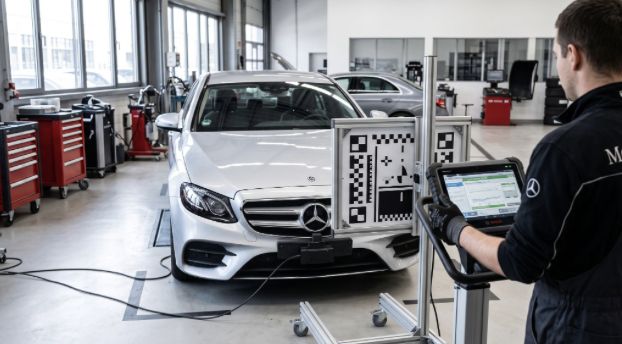
Luxury vehicles with ADAS sensors carry repair costs that standard insurance valuations underestimate. A forward collision camera embedded in a windshield requires recalibration after replacement. A single radar or camera unit on a Mercedes or BMW, plus required recalibration, commonly costs several hundred to a few thousand dollars, depending on the shop and whether OEM tools are required.
When a total-loss determination follows an ADAS crash, the insurer’s replacement value may understate the full sensor suite; documented differences on luxury vehicles can reach several thousand dollars.
Note: The views and opinions expressed in this article are those of the author(s) and/or interviewee(s) and do not necessarily reflect the official policy or position of Ocean Road Magazine, its publisher, or its staff. While every effort has been made to ensure the accuracy of the information provided, Ocean Road Magazine makes no representations or warranties of any kind regarding its completeness or reliability. Readers should conduct their own due diligence before making any decisions based on the content of this article.