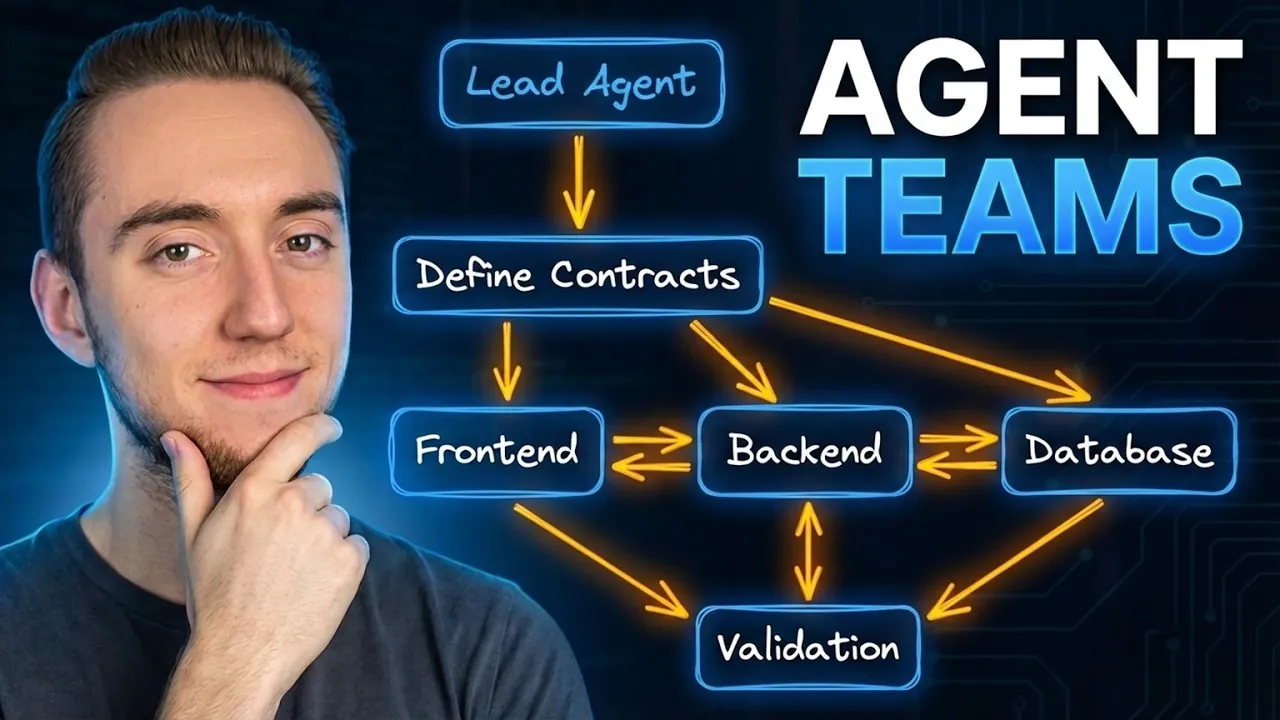
Claude Code’s experimental Agent Teams feature enables multiple autonomous agents to collaborate on complex programming tasks, as shown by Cole Medin in a live build of a payment integration for a chat application. This feature supports workflows like database updates, front-end design, and back-end token management, allowing agents to work in parallel. Its experimental status, however, brings challenges such as unpredictable behavior and high token usage, making careful planning essential for effective use.
In this quick-start guide, you will learn how to implement Agent Teams for multi-step projects using a “contract-first” approach to define task dependencies. Topics covered include assigning specific roles to agents, managing communication between them, and addressing common issues like resource constraints. These strategies will help you navigate the complexities of Agent Teams and apply them effectively to your development projects.
Understanding Claude Code Agent Teams
TL;DR Key Takeaways :
- Claude Code’s experimental Agent Teams feature enables multiple autonomous agents to collaborate and communicate, streamlining complex, multi-faceted tasks like payment integration.
- Agent Teams allow for parallel task execution across domains such as front-end design, back-end token management, and database updates, significantly reducing development time.
- Effective planning, such as a “contract-first” approach, is crucial for managing dependencies and making sure seamless inter-agent collaboration in complex projects.
- Challenges include unpredictable behavior, high token consumption, and technical complexity, but testing demonstrated the agents’ ability to autonomously resolve issues and improve workflows.
- Future improvements aim to enhance reliability, optimize token usage, and refine inter-agent communication, positioning Agent Teams as a cornerstone of collaborative AI development.
Agent Teams stand apart from traditional sub-agents by allowing inter-agent communication and autonomous task coordination. This functionality allows agents to collaborate across various domains, including:
- Front-end development: Designing user interfaces and improving user experience.
- Back-end token management: Making sure secure and efficient communication between services.
- Database updates: Managing and modifying data structures to support new features.
By working in parallel, these agents can significantly reduce development time and enhance task efficiency. For example, while one agent updates the database schema, another can focus on user authentication or front-end design. This parallelism makes Agent Teams particularly valuable for multi-faceted, complex projects where tasks are interdependent but can be executed simultaneously.
Step-by-Step Implementation of Payment Integration
To demonstrate the potential of Agent Teams, a payment integration was developed for a chat application using ChargeB as the payment platform. The process involved several critical tasks, each assigned to a specific agent:
- Database Schema Updates: The database was modified to store payment-related data, making sure compatibility with the new functionality.
- User Authentication: Supabase was integrated to provide secure identity verification for users accessing payment features.
- Front-End Billing Page: An intuitive interface was created to allow users to manage their payments easily.
- Back-End Token Handling: Secure and efficient communication between services was established to support the payment workflow.
Each agent worked autonomously yet collaboratively, reducing development time and showcasing the collaborative potential of Agent Teams. This division of labor not only streamlined the process but also highlighted the ability of agents to handle specialized tasks effectively.
How to Properly Use Claude Code Agent Teams

Here are additional guides from our expansive article library that you may find useful on Claude Code.
Strategic Planning for Agent Teams
Effective planning is essential for using the full potential of Agent Teams. A “contract-first” approach was adopted during the payment integration project to define task dependencies and ensure alignment among agents before execution. This method involved creating detailed task specifications, which acted as a blueprint for the agents.
For instance:
- Database schema updates were planned in tandem with back-end token management to ensure seamless integration.
- The design of the front-end billing page was coordinated with user authentication processes to provide a cohesive user experience.
By addressing dependencies upfront, potential errors were minimized, and execution was streamlined. This approach underscores the importance of meticulous planning when working with Agent Teams, particularly for projects involving multiple interconnected components.
Testing and Validation
Thorough testing and validation are critical to making sure the success of any project involving Agent Teams. In this case, end-to-end testing was conducted using the Vercel Agent Browser CLI, a tool designed to simulate user interactions and evaluate system functionality.
During the testing phase, agents autonomously identified and resolved discrepancies in token handling by adjusting back-end logic. This demonstrated not only the effectiveness of the payment integration but also the ability of Agent Teams to autonomously resolve issues, further emphasizing their value in complex workflows. Testing also highlighted areas for improvement, such as optimizing token usage and refining inter-agent communication.
Challenges and Limitations
While the implementation of Agent Teams showcased their strengths, several challenges were encountered:
- Unpredictable Behavior: As an experimental feature, Agent Teams occasionally exhibited inconsistencies in inter-agent communication, requiring manual intervention.
- High Token Consumption: The autonomous communication and coordination between agents resulted in significant token usage, which could impact scalability for larger projects.
- Technical Complexity: Managing dependencies and making sure seamless collaboration demanded careful planning and oversight.
Despite these challenges, the feature proved effective in reducing manual intervention and streamlining the development process. Addressing these limitations will be crucial for the broader adoption of Agent Teams in AI-driven development.
The Future of Agent Teams
The Agent Teams feature is poised to become a cornerstone of collaborative AI development. Over the next six months, several improvements are anticipated, including:
- Enhanced Reliability: Efforts to improve stability and reduce unpredictable behavior are expected to make the feature more dependable.
- Optimized Token Consumption: Refinements in communication protocols will likely reduce the resource demands of inter-agent coordination.
- Improved Communication: More intuitive mechanisms for inter-agent interaction will enhance their ability to collaborate effectively.
As these advancements are realized, Agent Teams are expected to play a pivotal role in agentic engineering workflows, allowing faster and more efficient software development. Their ability to handle complex, multi-faceted projects with minimal manual intervention positions them as a valuable tool for developers.
Maximizing the Potential of Agent Teams
Claude Code’s Agent Teams feature represents a significant advancement in collaborative AI development. By allowing multiple agents to work autonomously and in parallel, it has the potential to streamline complex tasks, such as payment integration, and reduce development time. While challenges like high token consumption and unpredictable behavior remain, the feature’s ability to improve efficiency and reduce manual workload makes it a promising addition to the AI development toolkit. As the technology matures, it is likely to become an indispensable resource for developers seeking to harness the power of collaborative AI workflows.
Media Credit: Cole Medin
Filed Under: AI, Guides
Disclosure: Some of our articles include affiliate links. If you buy something through one of these links, Geeky Gadgets may earn an affiliate commission. Learn about our Disclosure Policy.
Credit: Source link