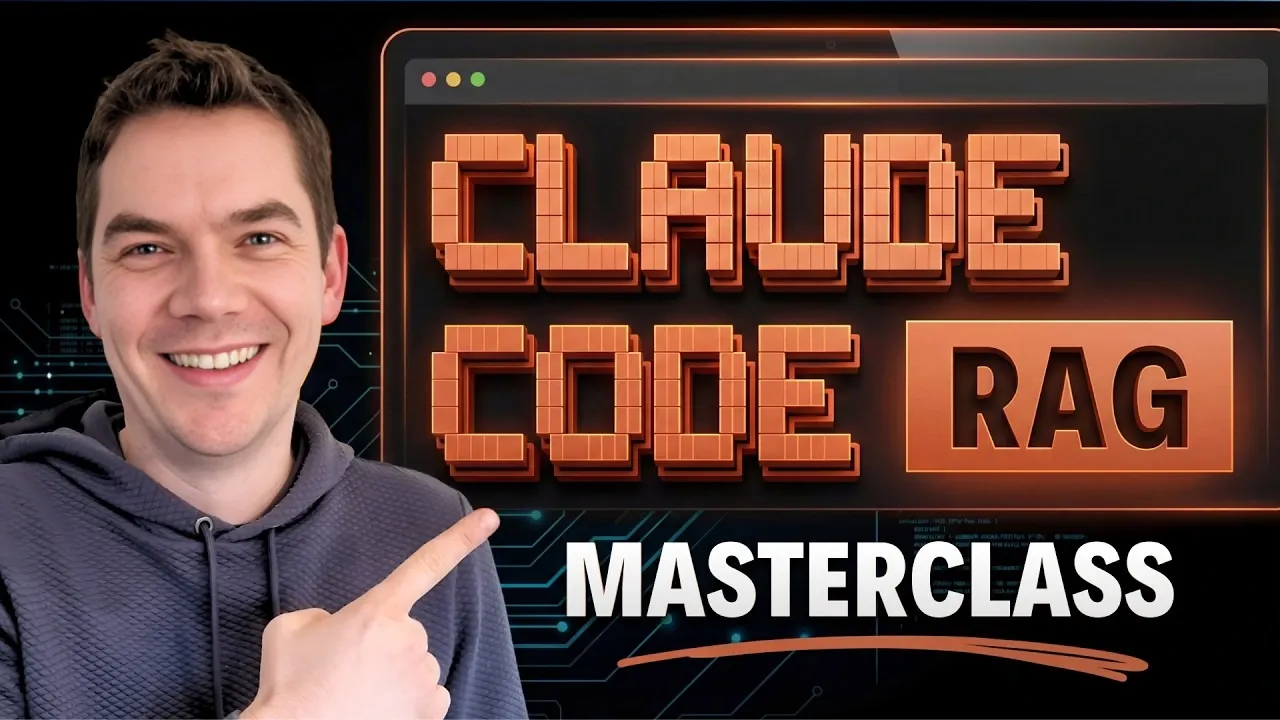
What if you could build an AI system that not only retrieves information with pinpoint accuracy but also adapts dynamically to complex tasks? Below, The AI Automators breaks down how to create a full-stack Retrieval-Augmented Generation (RAG) application in a detailed YouTube video, offering a step-by-step approach to mastering this innovative technology. With eight carefully designed modules, this analysis dives deep into the essential components of RAG development, from context management to hybrid search techniques. The result? A system that doesn’t just process data but transforms it into actionable, contextually relevant insights. Whether you’re a seasoned developer or new to AI, this guide promises to reshape the way you approach intelligent system design.
In this guide, you’ll uncover the secrets behind building a scalable and highly adaptable RAG system that integrates seamlessly with private, domain-specific data. Learn how to harness advanced features like text-to-SQL queries, metadata extraction, and sub-agents to handle complex workflows with ease. The video doesn’t just stop at the technical details, it also addresses common challenges like token optimization and database management, making sure your system is both robust and efficient. If you’ve ever wondered how to bridge the gap between AI innovation and practical application, this exploration offers a roadmap that’s as insightful as it is actionable.
Comprehensive RAG Development Guide
TL;DR Key Takeaways :
- Retrieval-Augmented Generation (RAG) systems dynamically integrate real-time external data, making sure outputs are accurate and contextually relevant, making them indispensable for domain-specific AI applications.
- A recommended tech stack for RAG development includes Python with FastAPI for backend, React with TypeScript for frontend, Supabase for vector search, Docling for document parsing, and both cloud-based and local AI models for flexibility.
- The RAG system development process is structured into eight modules, covering app shell setup, data ingestion, metadata extraction, hybrid search, and sub-agent deployment for handling complex tasks.
- Key challenges in RAG development include optimizing context window limits, streamlining document ingestion pipelines, and managing database integrity, all of which require careful planning and debugging.
- Testing, validation, and deployment are critical for making sure system reliability, with tools like LangSmith aiding in observability and tracing, and future enhancements focusing on advanced retrieval algorithms and expanded data format support.
Why Retrieval-Augmented Generation is Indispensable
Retrieval-Augmented Generation has emerged as a critical component for AI systems that require grounding in private, domain-specific data. Unlike conventional AI models that rely solely on pre-trained knowledge, RAG systems dynamically integrate external data sources in real-time, making sure outputs are both accurate and contextually relevant. The evolution to agentic RAG introduces advanced methodologies, such as combining text-to-SQL queries and graph-based retrieval, which significantly enhance precision, adaptability, and versatility. These advancements make RAG an essential tool for applications where data relevance and contextual accuracy are paramount.
The Essential Tech Stack for RAG Development
Building a scalable and efficient RAG application requires a carefully selected tech stack that supports backend and frontend operations, as well as robust data management. Below is the recommended stack for achieving optimal performance:
- Backend: Python with FastAPI for developing APIs that are both fast and scalable.
- Frontend: React with TypeScript, Tailwind CSS, and ShadCN UI for creating a responsive and user-friendly interface.
- Database: Supabase for vector search capabilities and secure file storage.
- Document Parsing: Docling for ingesting and processing multi-format documents, including PDFs and DOCX files.
- AI Models: Integration of both cloud-based models (OpenAI, OpenRouter) and local models (Quinn 3, LM Studio) for flexibility and scalability.
This tech stack ensures seamless communication between components, efficient data handling, and the flexibility to accommodate future upgrades or feature expansions.
Complete Agentic RAG Build 2026

Here is a selection of other guides from our extensive library of content you may find of interest on Retrieval-Augmented Generation (RAG).
Approaching Development: A Step-by-Step Process
The development of a RAG system is inherently iterative, requiring careful planning, execution, and validation at each stage. Collaborative AI coding tools, such as Claude Code, play a pivotal role in streamlining workflows by allowing parallel task execution. Specialized sub-agents can be deployed to handle tasks like document analysis and retrieval loops, while context management and token optimization ensure efficient resource utilization. This structured approach minimizes errors and maximizes productivity, allowing for a smoother development process.
Breaking Down the 8 Modules
The RAG system is constructed through eight interconnected modules, each addressing a critical aspect of the application. These modules work together to create a cohesive and functional system:
- App Shell: Establish the foundation by setting up user authentication, a chat interface, and basic OpenAI integration to enable core functionalities.
- Data Ingestion: Implement features like drag-and-drop file uploads, data chunking, embeddings, and real-time status updates to streamline data processing.
- Record Manager: Use hashing techniques to prevent duplicate file ingestion, making sure data integrity and efficient storage.
- Metadata Extraction: Extract structured metadata to enhance search accuracy and filtering capabilities.
- Multi-Format Support: Use Docling to parse a variety of document formats, including PDFs and DOCX files, for greater versatility.
- Hybrid Search and Re-Ranking: Combine keyword and vector search methods with re-ranking models to improve retrieval precision.
- Additional Tools: Integrate web search tools like Tavily and text-to-SQL capabilities to handle structured data queries effectively.
- Sub-Agents: Deploy isolated agents to perform full-document analysis and manage retrieval loops for complex tasks.
Each module builds upon the previous one, creating a robust and scalable RAG system that can adapt to a variety of use cases.
Addressing Common Challenges
Developing a RAG application is not without its challenges. Below are some common hurdles and strategies to overcome them:
- Context Window Limits: Optimize token usage to ensure responses remain accurate and relevant, even when dealing with large datasets.
- Document Ingestion Pipelines: Streamline pipelines to improve speed and resource efficiency, reducing processing time and system overhead.
- Database Management: Carefully handle database migrations and secure text-to-SQL queries to maintain data integrity and system reliability.
Effective debugging and logging are essential throughout the development process. These practices help identify and resolve issues quickly, making sure the system remains stable and functional.
Testing and Validation for Reliability
To ensure your RAG system performs as intended, rigorous testing and validation are crucial. Building a regression test suite allows you to validate features and identify potential issues. Tools like LangSmith provide observability and tracing for LLM calls, allowing you to monitor system performance and pinpoint bottlenecks. This step is critical for making sure the reliability, scalability, and overall robustness of your application.
Deployment and Future Enhancements
While this guide emphasizes local development, planning for deployment is an essential next step. Establish formal deployment pipelines with distinct stages for development, staging, and production. Incorporate version control and rollback mechanisms to assist smooth updates with minimal downtime. Production-grade testing should also be implemented to further enhance the system’s reliability and ensure it can handle real-world demands.
Looking ahead, consider expanding the system’s capabilities by integrating advanced RAG features, such as enhanced retrieval algorithms or support for additional data formats. These enhancements will not only improve the system’s functionality but also ensure it remains adaptable to evolving requirements.
Key Takeaways
Building an agentic RAG system requires a careful balance of collaboration, autonomy, and technical precision. By using AI-assisted coding tools and following a structured development process, you can streamline workflows while maintaining control over critical decisions. Robust debugging, logging, and iterative refinement are essential for creating a reliable and scalable application.
This guide provides a comprehensive foundation for developing production-grade RAG systems. By mastering these principles and techniques, you will be well-equipped to tackle complex AI development projects and deliver solutions that are both innovative and practical.
Media Credit: The AI Automators
Filed Under: AI, Guides
Latest Geeky Gadgets Deals
Disclosure: Some of our articles include affiliate links. If you buy something through one of these links, Geeky Gadgets may earn an affiliate commission. Learn about our Disclosure Policy.
Credit: Source link