Ethereum price prediction is one of the first things you look for when deciding whether now is the right time to invest. Ethereum is the second most valuable cryptocurrency after Bitcoin. When you buy Ethereum, you’re investing in a network that powers decentralized apps and much of the crypto economy.
In this article, we take you through Ethereum’s market snapshot, price history, and recent performance. We’ll break down technical analysis using moving averages and the Relative Strength Index (RSI), highlight key support and resistance levels, and share ETH price predictions for 2026 through 2030. Read on to learn more about Ethereum and its potential for long-term growth.
Ethereum (ETH) Overview
Ethereum (ETH) is the second-largest cryptocurrency by market capitalization, following Bitcoin. Launched in 2013 by Vitalik Buterin, Ethereum revolutionized the blockchain space by introducing smart contracts and decentralized applications (dApps). These innovations allow developers to create and deploy a wide range of decentralized solutions, from digital assets to ERC-20 tokens.
ETH, the native cryptocurrency of the Ethereum network, powers transactions and rewards participants within its ecosystem. With the transition to a proof-of-stake (PoS) consensus mechanism in 2022, Ethereum improved its scalability and energy efficiency, paving the way for future advancements.
ETH Market Snapshot
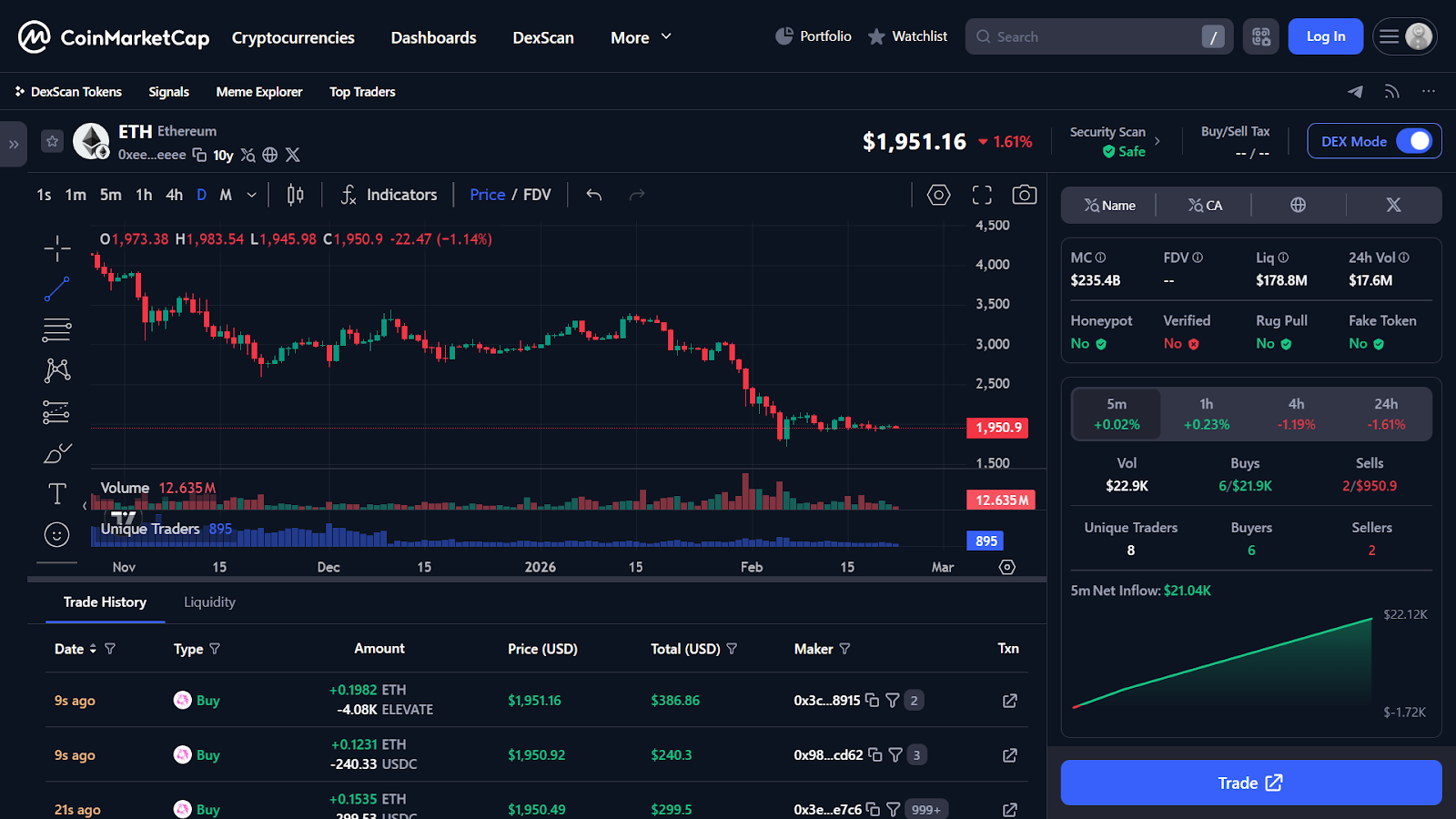
When we look at the Ethereum network and how it’s performing within the broader crypto market, a few clear things stand out right now. Ethereum’s native token, Ether (ETH), is trading in the low-to-mid $1900s in real time, with market capitalization sitting well above $235.25 billion, showing it remains one of the largest digital assets by total value. Price moves, volume, and sentiment are all visible in live market dashboards that track ETH versus USD across major exchanges.
Ethereum isn’t just a price ticker though. It operates a global decentralized blockchain that supports smart contracts and decentralized applications (dApps). This means ETH isn’t only traded like a commodity, it’s also digital fuel for activity on the network itself, from decentralized finance to non-fungible tokens and Web3 infrastructure.
In the context of the broader crypto market, Ethereum’s role is unique. Bitcoin often leads sentiment and macro price moves, but ETH’s price dynamics reflect network utility and adoption, such as growth in on-chain transaction activity and the increasing use of layer-2 scaling solutions. That makes understanding the network’s fundamentals just as important as watching price charts.
ETH Price History and Performance
The current Ethereum price fluctuates between $1,900 and $3,000 as of early 2026, reflecting a mix of market volatility and cautious investor sentiment. Since its launch in 2015, Ethereum has experienced significant price milestones, including an all-time high of $4,946 in August 2025. This peak was driven by increased adoption of decentralized finance (DeFi) and tokenized assets on the Ethereum blockchain.
Ethereum’s roadmap has played a pivotal role in shaping its performance. The transition to proof-of-stake (PoS) in 2022 marked a major milestone, reducing energy consumption and improving scalability. Upcoming upgrades, such as the Glamsterdam update, aim to further enhance network efficiency by increasing gas limits and improving Layer 2 interoperability. These developments are expected to strengthen Ethereum’s position as a leading blockchain for DeFi and smart contracts.
Ethereum (ETH) Technical Analysis
Ethereum (ETH) is currently trading between $1,900 and $3,000, reflecting a combination of market sentiment and ongoing developments on the Ethereum network. Key technical indicators, such as moving averages and the Relative Strength Index (RSI), offer insight into its price trends and possible future movements.
Moving Averages
ETH is trading below its 50-day EMA at $2,100 and its 200-day EMA at $2,300, indicating a bearish trend. The positioning of these moving averages reflects continued selling pressure, with the shorter-term average declining at a faster pace. A potential Golden Cross, when the 50-day EMA moves above the 200-day EMA, could signal a bullish reversal if market conditions strengthen.
Relative Strength Index (RSI)
Ethereum’s RSI is currently around 48, suggesting neutral momentum. A move below 30 would point to oversold conditions, while a rise above 70 would signal overbought territory, potentially leading to a price correction.
Key Price Levels
- Trading Range: $1,900 – $3,000
- Key Inflection Point: $2,000. Staying above this level supports near-term stability, while a drop below may open the door to further downside.
- Immediate Resistance: $2,300–$2,500. A strong move above this zone, backed by volume, would be needed to shift momentum in favor of buyers.
Support Levels
| Support Level | Price (USD) |
| S1 | $1,900 |
| S2 | $1,800 |
| S3 | $1,700 |
| S4 | $1,600 |
| S5 | $1,500 |
Resistance Levels
| Resistance Level | Price (USD) |
| R1 | $2,300 |
| R2 | $2,500 |
| R3 | $2,700 |
| R4 | $2,900 |
| R5 | $3,000 |
ETH Price Prediction 2027
| Month | Minimum Price (USD) | Average Price (USD) | Maximum Price (USD) | Expected ROI (%) |
| January | $2,400 | $3,150 | $3,900 | +95% |
| February | $2,410 | $3,160 | $3,910 | +96% |
| March | $2,420 | $3,170 | $3,920 | +97% |
| April | $2,430 | $3,180 | $3,930 | +98% |
| May | $2,440 | $3,190 | $3,940 | +99% |
| June | $2,450 | $3,200 | $3,950 | +100% |
| July | $2,460 | $3,210 | $3,960 | +101% |
| August | $2,470 | $3,220 | $3,970 | +102% |
| September | $2,480 | $3,230 | $3,980 | +103% |
| October | $2,490 | $3,240 | $3,990 | +104% |
| November | $2,500 | $3,250 | $4,000 | +105% |
| December | $2,510 | $3,260 | $4,010 | +106% |
ETH Price Prediction 2028
| Month | Minimum Price (USD) | Average Price (USD) | Maximum Price (USD) | Expected ROI (%) |
| January | $2,500 | $3,300 | $4,100 | +110% |
| February | $2,510 | $3,310 | $4,110 | +111% |
| March | $2,520 | $3,320 | $4,120 | +112% |
| April | $2,530 | $3,330 | $4,130 | +113% |
| May | $2,540 | $3,340 | $4,140 | +114% |
| June | $2,550 | $3,350 | $4,150 | +115% |
| July | $2,560 | $3,360 | $4,160 | +116% |
| August | $2,570 | $3,370 | $4,170 | +117% |
| September | $2,580 | $3,380 | $4,180 | +118% |
| October | $2,590 | $3,390 | $4,190 | +119% |
| November | $2,600 | $3,400 | $4,200 | +120% |
| December | $2,610 | $3,410 | $4,210 | +121% |
Long-term Outlook: ETH Price Prediction (2026–2030)
| Year | Minimum Price (USD) | Average Price (USD) | Maximum Price (USD) | Expected ROI (%) |
| 2026 | $1,900 | $3,100 | $3,900 | +95% |
| 2027 | $2,400 | $3,250 | $4,000 | +105% |
| 2028 | $2,500 | $3,400 | $4,200 | +120% |
| 2029 | $2,600 | $3,550 | $4,400 | +135% |
| 2030 | $2,700 | $3,700 | $4,600 | +150% |
What Factors Influence Ethereum’s Price?
Anyone planning to invest in Ethereum in 2026 should understand what truly drives its value. ETH does not move on headlines alone. Its price reflects network activity, capital flows, competition, and broader economic conditions. Here’s what shapes that movement.
1. Network Adoption and Real Utility
The Ethereum network runs thousands of decentralized applications, financial protocols, and digital asset platforms. Every interaction on the network requires ETH to process transactions. That built-in utility creates ongoing demand rather than relying purely on speculation.
2. Competition from Other Blockchains
Ethereum leads the smart contract space, yet it competes with networks that prioritize lower fees and faster transaction speeds. When you buy BNB, for example, you’re backing an ecosystem designed to offer cost efficiency and scalability. Developer migration to alternative chains can affect short-term growth.
3. Supply, Staking, and Scarcity
Ethereum’s move to Proof of Stake reshaped its supply model. Validators lock up ETH to secure the network and earn rewards, which reduces the amount available for active trading. At the same time, a portion of transaction fees is permanently burned, slowly decreasing total supply during periods of high activity.
4. Market Cycles and Investor Sentiment
Crypto markets operate in cycles. Bitcoin typically sets the overall direction, while Ethereum follows with higher volatility during both rallies and corrections. In strong bull markets, ETH often benefits from capital rotating into major alternative assets. During downturns, it tends to retrace alongside the broader market.
5. Gaming, Web3 Expansion, and Institutional Capital
As a gaming platform in crypto, Ethereum helped establish early blockchain gaming and digital asset ecosystems. While some projects operate on alternative networks, Ethereum continues to influence Web3 infrastructure and high-value decentralized applications. Broader adoption across gaming, tokenized assets, and decentralized finance expands network activity and strengthens demand for ETH.
Key Risks That Could Impact ETH’s Forecast
No Ethereum price prediction is complete without looking at the downside. Ethereum has strong fundamentals, but risk is part of crypto. Here are the key areas we monitor closely.
- Regulatory Uncertainty. Changes in government policy can quickly affect staking, exchanges, or decentralized finance platforms. Strict regulations may reduce liquidity or slow institutional participation. Even unclear guidance can create hesitation and short-term volatility.
- Network Congestion and High Gas Fees. When activity spikes on the Ethereum network, transaction costs can rise. High fees may push users and developers toward cheaper alternatives. Although layer-2 scaling solutions help reduce costs, adoption must continue smoothly to maintain competitiveness.
- Market Volatility and Macro Pressure. Crypto remains sensitive to global liquidity, interest rates, and investor risk appetite. Economic tightening or financial instability can trigger broad sell-offs. Ethereum often moves with overall market sentiment, especially during corrections.
- Security and Smart Contract Exploits. While Ethereum’s core protocol is secure, decentralized applications built on top of it can face hacks or vulnerabilities. Major exploits can shake confidence across the ecosystem and temporarily impact price momentum.
Final Thoughts
Ethereum remains one of the most important assets in the crypto market. The Ethereum network continues to power decentralized finance, digital assets, and Web3 innovation, giving ETH real utility beyond speculation. Long-term forecasts depend on adoption, supply dynamics, competition, regulation, and overall market cycles. Before you decide to buy Ethereum in 2026 or hold it long term, focus on fundamentals, not hype. Strong research and realistic expectations will always matter more than short-term price swings.
FAQs
Ethereum could potentially reach $10,000 by 2030, depending on adoption growth, DeFi expansion, and market conditions. However, this is speculative and not guaranteed.
Ethereum is considered a good long-term investment due to its dominance in DeFi, smart contracts, and continuous blockchain upgrades.
Ethereum is projected to trade between $1,900 and $3,900 in 2026, based on current market trends and its blockchain roadmap.
Ethereum staking is profitable, offering rewards for securing the network. Returns depend on the amount staked and network activity.
Yes, Ethereum often follows Bitcoin’s market cycle due to their correlation, but it also has unique drivers like DeFi and staking.
Credit: Source link