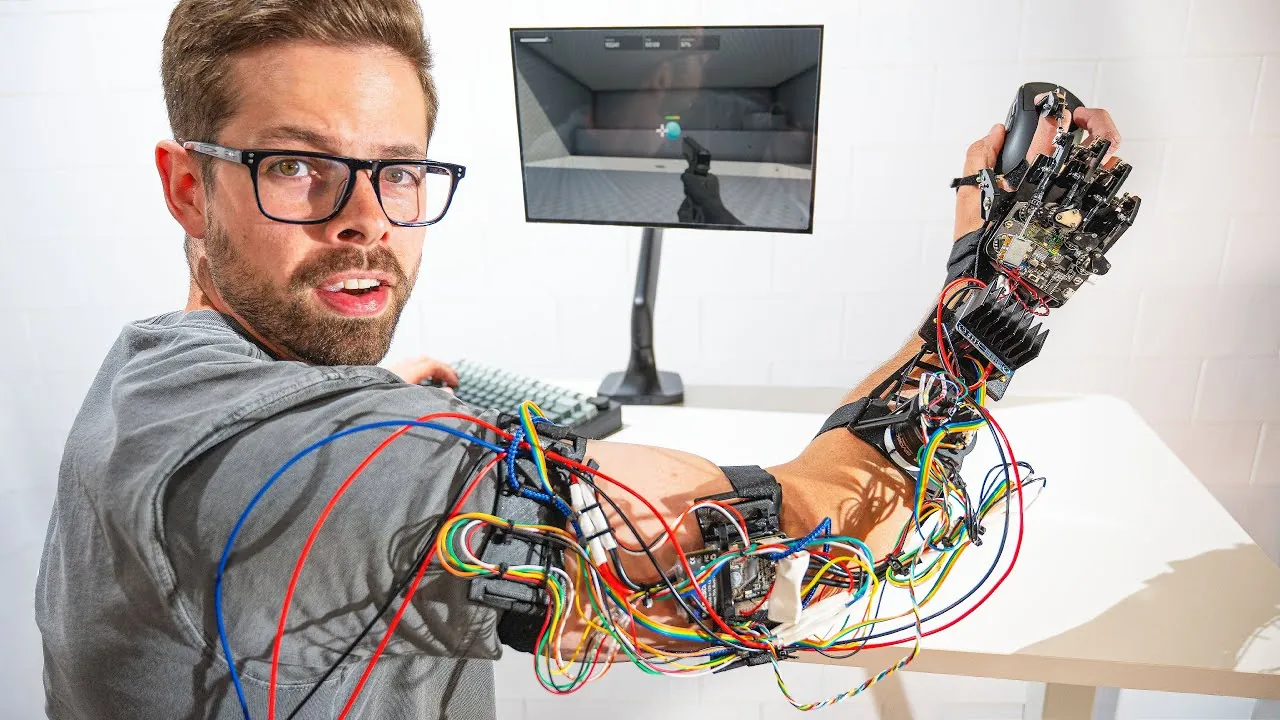
What if your reflexes could rival the precision of a machine? Imagine a device that doesn’t just enhance your gaming skills but fundamentally redefines what’s possible in competitive play. Enter the exoskeleton aim assist, a new fusion of robotics, computer vision, and mechanical engineering designed to elevate player performance to unprecedented heights. By seamlessly integrating advanced hardware and AI-driven software, this innovation promises to transform how we interact with games, offering a level of precision and responsiveness that feels almost superhuman. Whether you’re a seasoned esports competitor or a casual gamer chasing the thrill of perfection, this technology challenges the limits of human capability in ways that are both thrilling and provocative.
In this feature, Basically Homeless explain how the exoskeleton aim assist system achieves its extraordinary results, from motorized wrist adjustments that deliver pinpoint accuracy to AI-powered target recognition that reacts faster than the human eye. You’ll uncover the intricate mechanisms behind its real-time responsiveness and the technical hurdles its creators overcame to make it a reality. But this isn’t just about gaming, this innovation hints at a future where human-machine integration could transform industries beyond entertainment. Could this be the dawn of a new era in precision technology? Let’s delve into the possibilities and discover how this device is reshaping the playing field, one millisecond at a time.
Exoskeleton Aim Assist Overview
TL;DR Key Takeaways :
- The exoskeleton-based aim assist device combines robotics, computer vision, and mechanical engineering to enhance gaming performance, focusing on wrist movements and finger precision.
- Key components include motorized wrist adjustments, solenoid mechanisms for rapid finger actions, and YOLO-powered computer vision for accurate target identification.
- Technical challenges like latency reduction (achieving 17ms) and power management were overcome using advanced hardware like the Nvidia Jetson AGX Orin processor and a high-speed global shutter camera.
- In competitive testing, the device demonstrated exceptional performance, achieving precise aim assist and rapid target acquisition, securing a second-place finish in trials.
- Future developments aim to integrate neuromuscular technology, enhancing gaming precision and expanding applications to assistive technologies for individuals with motor impairments.
Core Mechanisms of the Aim Assist System
The exoskeleton aim assist system operates through a sophisticated combination of hardware and software, making sure seamless functionality. Its primary components include:
- Motorized Wrist Movement: Using Kevlar lines and gimbal motors, the system delivers precise and controlled wrist adjustments, allowing smooth and accurate in-game movements.
- Solenoid Mechanisms: These mechanisms provide rapid and precise finger-clicking capabilities, a critical feature for fast-paced gaming scenarios where split-second decisions matter.
- Computer Vision: Using the YOLO (You Only Look Once) AI model, the system identifies in-game targets with remarkable speed and accuracy, enhancing the user’s ability to react and aim effectively.
Together, these components form a cohesive system that significantly enhances gaming performance by improving precision, reducing human error, and allowing players to maintain a competitive edge.
Overcoming Technical Barriers
Developing a system capable of delivering real-time responsiveness required addressing several complex technical challenges. The primary hurdles included:
- Latency Reduction: Achieving sub-25ms latency was critical for smooth gameplay. This involved optimizing wiring, encoders, and motor controllers to minimize delays and ensure seamless operation.
- Power Management: Maintaining consistent performance under high loads necessitated the development of a robust power delivery system capable of handling the device’s demands.
To meet these challenges, the development team incorporated the Nvidia Jetson AGX Orin processor, a robotics-focused chip designed to handle complex AI algorithms and motor control tasks efficiently. Additionally, a high-speed global shutter camera was integrated to minimize latency in capturing and processing visual data. These innovations enabled the system to achieve an impressive latency of just 17ms, making sure real-time responsiveness and a fluid gaming experience.
Exoskeleton Aim Assist Project 2025

Below are more guides on humanoid robots from our extensive range of articles.
Demonstrated Performance in Competitive Scenarios
The prototype of the exoskeleton aim assist system was rigorously tested in competitive gaming environments, where it showcased its capabilities under pressure. During testing, the device achieved a second-place finish, demonstrating its potential to enhance player performance. Key features contributing to its success included:
- Precise Aim Assist: The motorized wrist system provided unparalleled accuracy in targeting, allowing players to execute precise movements effortlessly.
- Rapid Target Acquisition: The YOLO-powered computer vision system enabled swift identification and tracking of in-game targets, a critical advantage in fast-paced gameplay.
These results highlight the fantastic potential of robotics and engineering in competitive gaming, offering players a significant edge and redefining the standards of performance in the industry.
Exploring Future Possibilities: Neuromuscular Integration
The next phase of development for exoskeleton aim assist technology lies in neuromuscular integration. By combining the mechanical precision of the device with the user’s natural muscle movements, future iterations could achieve unprecedented levels of accuracy and responsiveness. This integration has the potential to:
- Enhance Competitive Gaming: By creating a seamless connection between the player and the device, neuromuscular integration could transform the gaming experience, allowing for more intuitive and precise control.
- Expand into Assistive Technologies: Beyond gaming, this technology could be adapted to assist individuals with motor impairments, offering new solutions for improving mobility and dexterity.
Such advancements could pave the way for a new era of precision gaming and broader applications in assistive devices, further demonstrating the versatility and impact of this innovative technology.
Pioneering the Future of Gaming Technology
The exoskeleton aim assist project exemplifies the power of robotics, computer vision, and mechanical engineering to push the boundaries of gaming technology. By overcoming complex technical challenges and achieving near-real-time responsiveness, the device delivers a significant leap in performance. With future innovations like neuromuscular integration on the horizon, this technology holds the potential to redefine precision gaming and extend its applications into assistive technologies, marking a pivotal moment in the evolution of human-machine interaction.
Media Credit: Basically Homeless
Filed Under: AI, DIY Projects, Gaming News, Guides
Latest Geeky Gadgets Deals
Disclosure: Some of our articles include affiliate links. If you buy something through one of these links, Geeky Gadgets may earn an affiliate commission. Learn about our Disclosure Policy.
Credit: Source link