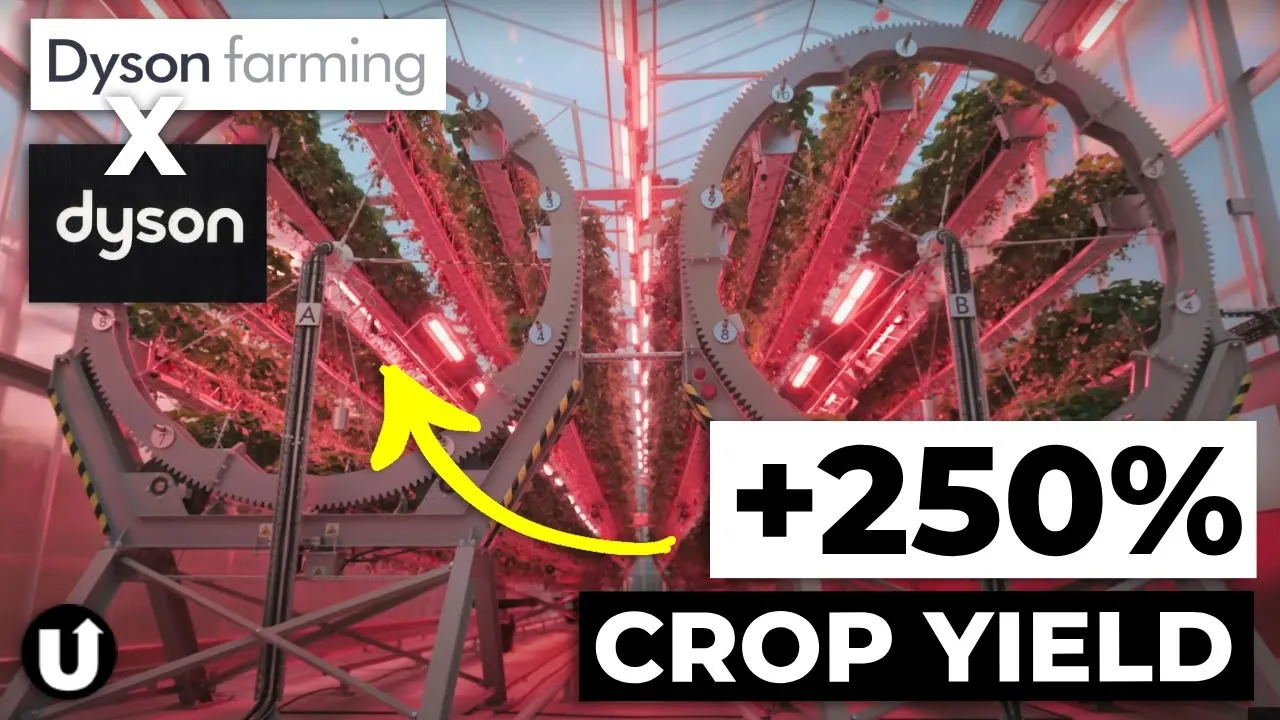
What if the future of farming didn’t involve sprawling fields or endless rows of crops under the open sky? What if the solution to feeding a growing global population lay not in expanding farmland but in building upward? Enter Dyson, a company renowned for its engineering ingenuity, now turning its sights to agriculture. With its new approach to vertical farming, Dyson claims to have cracked the code on producing more food with fewer resources, all while prioritizing sustainability. At their Carrington facility in the UK, they’ve combined innovative technology with a deep commitment to environmental stewardship, creating a model that could redefine how we grow and consume food. Could this be the breakthrough the agricultural industry has been waiting for?
Upshift explore how Dyson’s innovative system, complete with rotating rigs, automation, and renewable energy, achieves yields that are 2.5 times higher than traditional methods, all while slashing environmental impact. You’ll discover how their hybrid greenhouse model balances natural sunlight with artificial inputs to optimize growth, and how their closed-loop system transforms waste into energy. But Dyson’s ambitions don’t stop at vertical farming; their broader commitment to regenerative agriculture and biodiversity restoration paints a vision of farming that works in harmony with nature. As we unpack the details, one question lingers: could Dyson’s approach be the key to a more sustainable and scalable food system?
Dyson’s Vertical Farming
TL;DR Key Takeaways :
- Dyson Farming has transformed vertical farming by integrating rotating rigs, automation, and renewable energy, achieving 2.5 times the yield of traditional greenhouses while minimizing environmental impact.
- The hybrid greenhouse model combines natural sunlight with artificial inputs, reducing energy consumption and offering a sustainable alternative to fully indoor vertical farming systems.
- Sustainability is central to Dyson’s operations, using rainwater collection, anaerobic digesters for biogas production, and recycling waste heat and CO2 to power greenhouses and reduce emissions.
- Regenerative agriculture practices, such as cover cropping, agroforestry, and natural fertilization, enhance soil health, biodiversity, and carbon sequestration, while sheep grazing eliminates the need for herbicides.
- Advanced technology, including drones, satellite data, and precision machinery, optimizes resource use, reduces waste, and minimizes chemical inputs, setting a new standard for sustainable and efficient farming.
Dyson Innovative Growing Techniques
At the heart of Dyson’s vertical farming success are rotating rigs, a unique feature that ensures plants receive uniform sunlight exposure. This design optimizes growth conditions, leading to significantly higher yields compared to conventional methods. Automation plays a crucial role as well, streamlining essential processes such as harvesting, pest control, and mold prevention. These technologies not only reduce labor costs but also improve efficiency and overall productivity. The Carrington facility, for instance, achieves an impressive 2.5 times the yield of traditional greenhouses, demonstrating its potential to meet the growing global demand for food.
Dyson’s approach also incorporates a hybrid greenhouse model, which combines natural sunlight with artificial inputs to create an optimal growing environment. This balance reduces energy consumption while maintaining high productivity, making it a more sustainable and cost-effective solution compared to fully indoor vertical farming systems.
Commitment to Sustainability
Sustainability is a cornerstone of Dyson’s farming operations. The greenhouses are designed to maximize the use of natural sunlight and collect rainwater, reducing dependence on artificial resources. Dyson also employs anaerobic digesters to convert organic waste into biogas, which powers electricity, heating, and even tractors. This closed-loop system ensures that waste is repurposed efficiently, minimizing environmental impact.
Additionally, waste heat and CO2 generated during biogas production are recycled within the greenhouses. This innovative approach improves energy efficiency while reducing emissions, showcasing Dyson’s commitment to creating a sustainable farming model. By integrating renewable energy and resource recycling, Dyson Farming sets an example of how agriculture can operate in harmony with the environment.
Dyson Might Just Have Solved Vertical Farming

Stay informed about the latest in energy technology by exploring our other resources and articles.
Regenerative Agriculture in Action
Beyond vertical farming, Dyson Farming actively incorporates regenerative agriculture practices across its landholdings to restore and enhance the health of ecosystems. These practices include:
- Planting cover crops to enrich soil health, prevent erosion, and improve water retention.
- Implementing agroforestry techniques to boost biodiversity and increase carbon sequestration.
- Using natural fertilization methods, such as composting, to reduce reliance on chemical inputs.
Sheep grazing has been reintroduced as a natural method of weed control, eliminating the need for herbicides and promoting healthier soil. Dyson also focuses on habitat restoration by revitalizing watercourses and hedgerows, which support local wildlife and enhance biodiversity. These efforts demonstrate how modern farming can coexist with environmental conservation, creating a balanced and sustainable agricultural system.
Technology-Driven Farming
Dyson Farming uses advanced technology to enhance precision and efficiency in agricultural practices. Tools such as cameras, drones, and satellite data enable real-time monitoring of crops, allowing for targeted irrigation and fertilization. These methods not only reduce resource consumption but also minimize waste, making sure that inputs are used efficiently.
Advanced machinery further supports sustainability by reducing herbicide use by up to 90%, a significant achievement in minimizing chemical impact on the environment. By integrating technology into its operations, Dyson Farming demonstrates how traditional farming methods can evolve into a more efficient and environmentally friendly practice, paving the way for a smarter agricultural future.
Economic and Environmental Benefits
Dyson’s innovative approach delivers benefits that extend beyond the farm. Locally grown strawberries from the Carrington facility are consistently high in quality and sweetness, meeting consumer expectations while reducing the carbon footprint associated with long-distance transportation. By optimizing resource use and scaling innovations responsibly, Dyson Farming proves that agriculture can be both economically viable and environmentally sustainable.
The economic advantages of Dyson’s model are further amplified by its focus on efficiency and waste reduction. By producing higher yields with fewer resources, Dyson Farming not only meets market demands but also contributes to a more sustainable global food system. This dual focus on profitability and environmental stewardship sets a precedent for the agricultural industry.
Challenges Facing Vertical Farming
Despite its promise, the vertical farming industry faces several challenges. High costs associated with energy, labor, and artificial lighting have led to the failure of many startups. Poor crop selection, rapid scaling, and financial mismanagement have further hindered progress in the sector. Dyson addresses these challenges by adopting a hybrid greenhouse model, which balances natural and artificial inputs to create a more sustainable and cost-effective solution.
This approach reduces reliance on energy-intensive artificial lighting while maintaining high productivity, offering a viable alternative to fully indoor vertical farming systems. By carefully managing resources and scaling innovations responsibly, Dyson Farming demonstrates how the challenges of vertical farming can be overcome.
A Vision for Scalable Agriculture
Dyson Farming’s innovative approach highlights the potential of combining traditional agricultural methods with modern technology. By addressing the limitations of both conventional farming and fully indoor vertical systems, Dyson has developed a scalable and sustainable model that could reshape the future of agriculture. With its emphasis on innovation, efficiency, and environmental stewardship, Dyson Farming sets a new standard for the industry, offering a blueprint for a more resilient and sustainable global food system.
This vision underscores the importance of balancing technological advancements with ecological responsibility. As the global population continues to grow, Dyson’s model provides a compelling solution to the challenges of food security and environmental sustainability, demonstrating that agriculture can evolve to meet the needs of the future without compromising the health of the planet.
Media Credit: The Upshift
Filed Under: Design News, Top News
Latest Geeky Gadgets Deals
Disclosure: Some of our articles include affiliate links. If you buy something through one of these links, Geeky Gadgets may earn an affiliate commission. Learn about our Disclosure Policy.
Credit: Source link