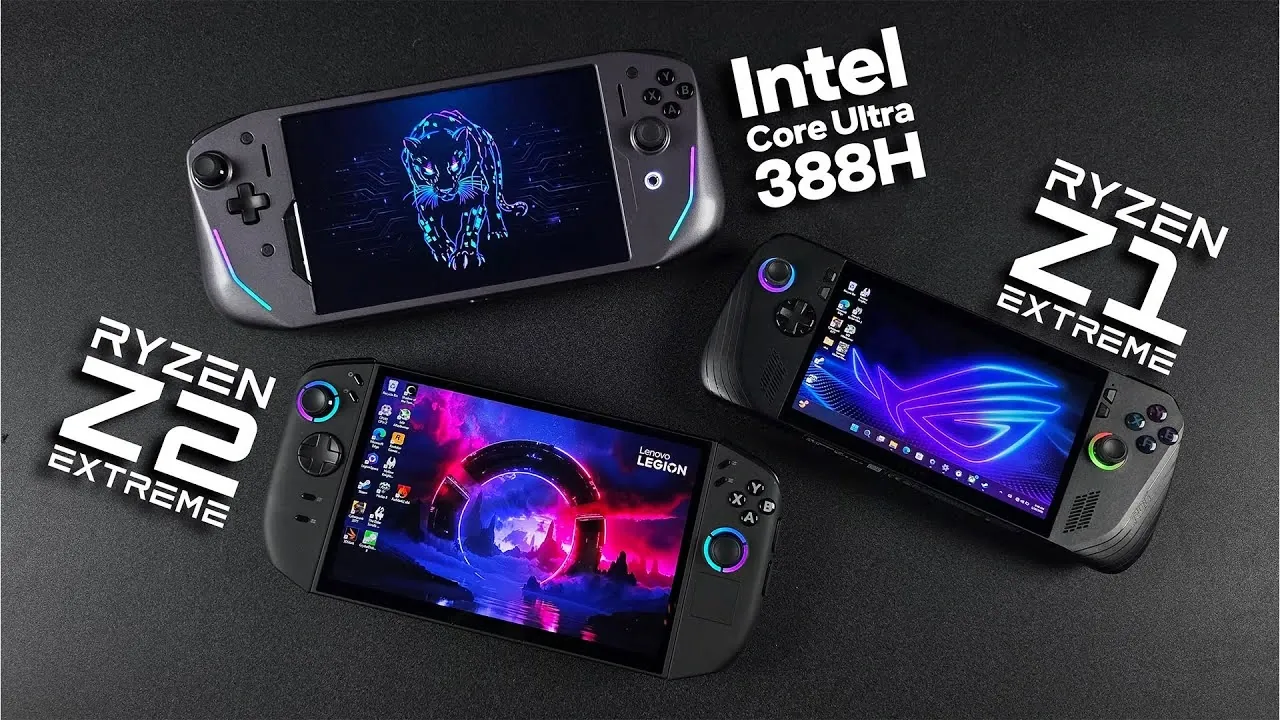
What if the battle for handheld gaming supremacy wasn’t just about portability but about raw power and efficiency? Below, ETA Prime takes you through how Intel’s Panther Lake Core Ultra X9 388H is shaking up the game, going head-to-head with AMD’s Ryzen Z2 Extreme in a showdown that redefines what handheld gaming PCs can achieve. With a hybrid architecture boasting 16 cores and Intel Arc B390 integrated graphics, Panther Lake is not only outpacing its competition but also challenging the very limits of energy-efficient gaming. The stakes? A 40% boost in performance over AMD’s Z1 Extreme and a 30% edge over the Z2 Extreme at 25W TDP, numbers that could make any gamer rethink their setup. If you’ve ever wondered what’s next for handheld gaming, this guide is your window into the future.
In this breakdown, you’ll discover how these processors stack up in real-world gaming scenarios, from Cyberpunk 2077 to Shadow of the Tomb Raider, and why Intel’s latest chip is setting new benchmarks for performance and longevity. Whether it’s the smooth gameplay powered by Panther Lake’s superior FPS or the promise of extended gaming sessions without sacrificing power, the insights here are bound to surprise you. But it’s not just about the numbers, this is about how these advancements translate to a more immersive, seamless gaming experience. Is this the dawn of a new era in handheld gaming, or just another incremental step? Let’s explore the details and see where the future is headed.
Panther Lake vs Ryzen Extreme Z
TL;DR Key Takeaways :
- Intel’s Panther Lake Core Ultra X9 388H introduces a hybrid architecture with 16 cores and Intel Arc B390 integrated graphics, delivering superior power efficiency and performance for handheld gaming PCs.
- At both 17W and 25W TDP, Panther Lake outperforms AMD’s Ryzen Z1 Extreme and Z2 Extreme in benchmarks, gaming performance, and power efficiency, setting a new standard for handheld gaming processors.
- Benchmark results show Panther Lake achieving up to 40% better single-core and multi-core performance and significantly higher graphical performance compared to AMD’s chips.
- In real-world gaming tests, Panther Lake consistently delivers smoother gameplay with up to 40% higher FPS over the Z1 Extreme and 30% over the Z2 Extreme, enhancing the handheld gaming experience.
- Intel is actively developing custom chips and driver optimizations for handheld devices, making sure long-term support and further advancements in power efficiency and performance.
Intel Panther Lake a New Era in Handheld Computing
Intel’s Panther Lake Core Ultra X9 388H represents a significant leap forward in handheld gaming technology. Featuring a hybrid architecture with 16 cores, comprising 4 performance cores, 8 efficiency cores, and 4 low-power efficiency cores, it is designed to balance power and performance seamlessly. The inclusion of Intel Arc B390 integrated graphics (iGPU) further enhances its capabilities, particularly for gaming and other graphics-intensive tasks.
At both 17W and 25W TDP, the Panther Lake chip consistently outperforms its AMD counterparts in synthetic benchmarks and real-world gaming scenarios. Its ability to deliver high performance while maintaining excellent power efficiency makes it a standout choice for next-generation handheld gaming PCs. This processor not only meets the demands of modern gaming but also sets a new benchmark for energy-efficient computing.
AMD Ryzen Z1 & Z2 Extreme: Solid Options, But Outpaced
AMD’s Ryzen Z1 Extreme, built on the Zen 4 architecture, has been a reliable choice for handheld gaming PCs. With 8 cores and 12 RDNA 3 compute units, it offers solid performance for most gaming applications. However, when tested at 17W, the Z1 Extreme struggles to match the Panther Lake chip in key areas such as single-core and multi-core benchmarks, as well as gaming performance. While it remains a dependable option, it is increasingly overshadowed by Intel’s advancements.
The Ryzen Z2 Extreme, AMD’s follow-up to the Z1 Extreme, incorporates the Zen 5 architecture with a mix of 3 Zen 5 cores and 5 Zen 5C cores. It also features 16 RDNA 3.5 compute units, delivering improved graphics performance. Despite these upgrades, the Z2 Extreme still lags behind Panther Lake in critical metrics, including multi-core processing power and gaming frame rates. While it represents progress for AMD, it does not close the gap with Intel’s latest offering.
Panther Lake vs Z2 Extreme Benchmarks

Gain further expertise in handheld games by checking out these recommendations.
Benchmark Analysis: Panther Lake Leads the Pack
Performance benchmarks provide a clear picture of Panther Lake’s dominance over its AMD competitors. The results highlight its superior computational and graphical capabilities, making it the top choice for demanding applications.
- Geekbench 6: At 25W, Panther Lake outperforms the Z1 Extreme by up to 40% in single-core and multi-core performance. It also maintains a 30% advantage over the Z2 Extreme, showcasing its processing power.
- 3DMark Time Spy: In graphics tests, Panther Lake achieves 83% higher scores than the Z1 Extreme and 58% higher than the Z2 Extreme at 17W TDP, solidifying its position as a leader in graphical performance.
These benchmarks underline Panther Lake’s ability to handle both computational and graphical workloads with ease, making it a compelling choice for gamers and power users alike.
Gaming Performance: Elevating the Handheld Experience
Gaming tests further emphasize Panther Lake’s superiority in real-world scenarios. In popular titles such as Cyberpunk 2077, Shadow of the Tomb Raider, and Forza Horizon 5, the processor consistently delivers higher frames per second (FPS) at both 17W and 25W TDP. On average, Panther Lake provides a 40% FPS boost over the Z1 Extreme and a 30% increase over the Z2 Extreme. This translates to smoother gameplay, reduced latency, and a more immersive experience for handheld gamers.
The combination of high frame rates and efficient power usage ensures that gamers can enjoy extended play sessions without compromising on performance. Whether tackling graphically demanding games or engaging in competitive multiplayer matches, Panther Lake delivers a seamless gaming experience.
Future Developments: Custom Chips and Driver Optimization
Intel’s commitment to innovation in the handheld gaming market extends beyond the Panther Lake processor. The company is actively developing custom chips tailored specifically for handheld devices, aiming to further enhance power efficiency and performance. These advancements could redefine the capabilities of handheld gaming PCs, offering users even greater flexibility and functionality.
Additionally, Intel’s ongoing driver updates are expected to optimize the Panther Lake chip’s performance over time. These updates will likely improve compatibility with new games and applications, making sure that the processor remains competitive as gaming technology continues to evolve. For gamers and developers alike, this focus on long-term support adds significant value to the Panther Lake platform.
Choosing the Right Processor for Your Needs
For those considering a new handheld gaming PC or looking to upgrade their current setup, the Panther Lake Core Ultra X9 388H stands out as a future-proof option. Its superior performance at both 17W and 25W TDP makes it an ideal choice for gaming enthusiasts who demand the best in power and efficiency. While AMD’s Ryzen Z1 and Z2 Extreme processors remain viable options, particularly for existing users, they fall short of the advancements offered by Panther Lake.
Intel’s latest processor not only redefines expectations for handheld gaming PCs but also sets a new standard for what these devices can achieve. Whether you’re a casual gamer or a dedicated enthusiast, Panther Lake offers the performance and reliability needed to stay ahead in the ever-evolving world of handheld gaming.
Media Credit: ETA PRIME
Filed Under: Gaming News, Hardware
Latest Geeky Gadgets Deals
Disclosure: Some of our articles include affiliate links. If you buy something through one of these links, Geeky Gadgets may earn an affiliate commission. Learn about our Disclosure Policy.
Credit: Source link