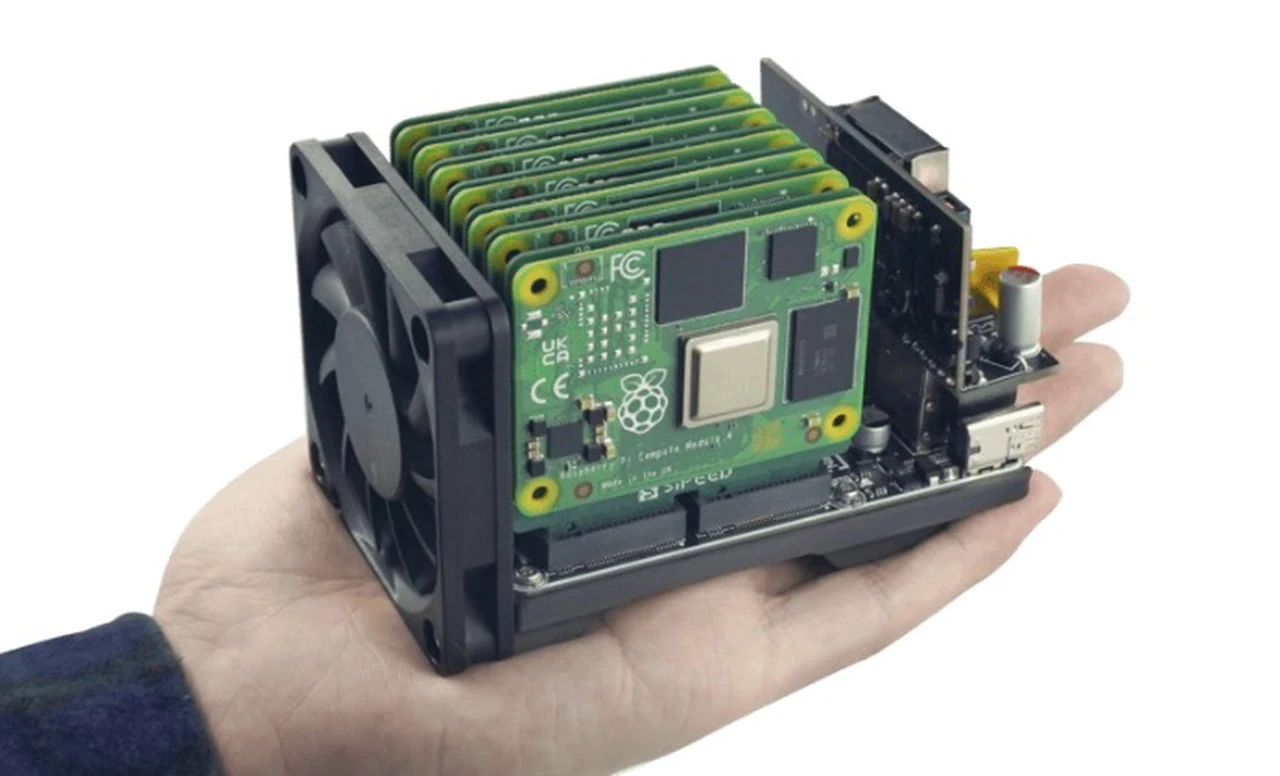
What if you could hold the power of a fully functional cluster computer in the palm of your hand? The Sipeed NanoCluster is turning that vision into reality, offering a new solution for Raspberry Pi enthusiasts, IoT developers, and tech hobbyists alike. Gone are the days of tangled cables, bulky setups, and endless troubleshooting, this compact marvel integrates up to seven compute modules into a single, streamlined board. With its built-in cooling system, gigabit network switch, and USB-C power delivery, the NanoCluster is more than just a tool; it’s a gateway to efficient and accessible cluster computing for lightweight tasks and experimental projects.
Below Michael Klements explains how the NanoCluster is reshaping the landscape of compact computing, from its modular design to its seamless networking capabilities. Whether you’re building Kubernetes clusters, experimenting with IoT devices, or running self-hosted systems, this device offers a practical and customizable platform to bring your ideas to life. But is it the perfect fit for your needs? With its impressive features come some trade-offs, such as power limitations and potential space constraints. Join us as we unpack the possibilities and limitations of this innovative tool, and discover what makes the NanoCluster a standout choice for modern tech enthusiasts. Sometimes, the smallest packages hold the biggest potential.
Compact Pi CM4/CM5 Cluster Computing
TL;DR Key Takeaways :
- The Sipeed NanoCluster simplifies compact cluster computing with a modular design, integrating up to seven compute modules and reducing cabling and power supply needs.
- Key features include an 8-port managed gigabit network switch, USB-C power input (up to 65W), optional PoE, and a built-in cooling system with status LEDs for efficient performance and monitoring.
- It supports Raspberry Pi CM4/CM5 and Sipeed M3H/M4N modules, with adapter boards available for additional functionality like microSD and NVMe SSD support.
- Ideal for lightweight tasks such as Kubernetes clusters, IoT projects, and self-hosted systems, it delivers stable thermal performance and high-speed node communication (up to 950 Mbps).
- Pricing starts at $49 for the basic board, with customizable options and 3D-printed enclosures, making it accessible for hobbyists, developers, and educators.
Design and Features: Efficiency at Its Core
The NanoCluster is engineered with a focus on usability and efficiency, offering a compact form factor that accommodates up to seven system-on-module (SOM) slots. This design enables users to create a powerful cluster while maintaining a minimal physical footprint. One of its standout features is the integrated 8-port managed gigabit network switch, which includes a user-friendly web-based dashboard for intuitive network management. This ensures seamless, high-speed communication between nodes, making the NanoCluster ideal for distributed computing tasks.
The board excels in power delivery, supporting USB-C power input of up to 65W and offering optional Power over Ethernet (PoE) for added flexibility. Essential interfaces such as USB 2.0, HDMI, and Ethernet are included, with slot one designated as the master node for centralized control. To ensure optimal performance, the NanoCluster is equipped with a built-in 60mm cooling fan and status LEDs for each node, providing effective thermal management and real-time monitoring. These features collectively make the NanoCluster a robust and user-friendly platform for compact cluster computing.
Compatibility and Customization Options
The NanoCluster is designed to be compatible with a variety of compute modules, including Raspberry Pi CM4 and CM5, as well as Sipeed’s M3H and M4N modules. For users requiring additional functionality, adapter boards are available, offering features such as microSD slots and NVMe SSD support. This flexibility allows users to tailor their setups to meet specific requirements, whether they prioritize storage capacity, processing power, or cost efficiency. Despite its versatility, there are some limitations to consider:
- The power input is capped at 60W, which restricts the number of high-power modules (e.g., CM5 or M4N) to a maximum of four.
- Space constraints may arise when using heat sinks or SSDs, potentially reducing the number of usable slots.
However, the NanoCluster’s integrated cooling system ensures stable thermal performance even without additional heat sinks. It is worth noting that the cooling fan may produce noticeable noise during operation, which could be a consideration for noise-sensitive environments.
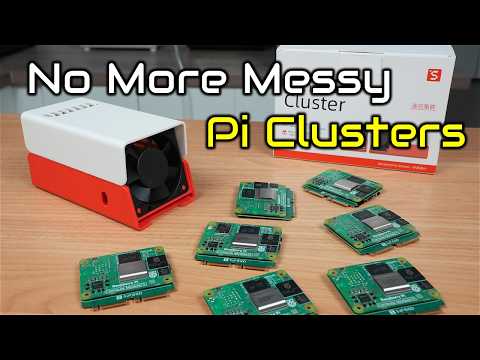
A Pi Cluster That Fits in the Palm of Your Hand
Learn more about Raspberry Pi 5 hardware and projects by reading our previous articles, guides and features :
Performance and Applications: Practical and Versatile
The NanoCluster excels in scenarios that demand compact and efficient cluster computing. It is particularly well-suited for:
- Running Kubernetes clusters for containerized applications
- IoT projects requiring distributed processing
- Self-hosted systems for personal or educational use
While the NanoCluster is not intended to replace large-scale cloud servers or high-performance NAS systems, it provides an excellent platform for lightweight tasks, experimentation, and learning. Its design makes it an ideal choice for developers and educators exploring distributed computing concepts.
Performance testing reveals the NanoCluster’s capabilities in handling computational tasks, with significant improvements observed compared to older Raspberry Pi clusters. Network speeds between nodes reach approximately 950 Mbps, making sure efficient data transfer for distributed workloads. Thermal performance remains stable under stress tests, with no throttling detected, highlighting the effectiveness of its cooling system. These results demonstrate the NanoCluster’s ability to deliver reliable performance for a variety of practical applications.
Cost and Personalization
The NanoCluster offers a range of customization options, including support for 3D-printed enclosures. Design files are readily available, allowing users to create housings that align with their aesthetic and functional preferences. This feature is particularly appealing to hobbyists who value a personalized setup. In terms of pricing, the NanoCluster is accessible to a wide audience, with options to suit different budgets:
- Basic board and fan: Starting at $49
- Fully equipped packages (including modules and accessories): Up to $699
This pricing structure ensures that the NanoCluster is within reach for both budget-conscious users and those seeking a comprehensive, ready-to-use solution. Its affordability, combined with its modular design and customization options, makes it an attractive choice for a diverse range of users.
A Practical Tool for Cluster Computing Enthusiasts
The Sipeed NanoCluster represents a significant advancement in compact cluster computing. By combining modularity, efficient power delivery, and robust networking capabilities, it offers a streamlined and practical solution for hobbyists, developers, and educators. While it does have limitations in terms of power and space, its performance, versatility, and affordability make it an excellent choice for IoT integration, Kubernetes clusters, and self-hosted systems. With its accessible pricing and customization options, the NanoCluster is a valuable tool for anyone looking to explore the possibilities of cluster computing in a compact and efficient form.
Media Credit: Michael Klements
Filed Under: Hardware, Technology News
Latest Geeky Gadgets Deals
Disclosure: Some of our articles include affiliate links. If you buy something through one of these links, Geeky Gadgets may earn an affiliate commission. Learn about our Disclosure Policy.
Credit: Source link