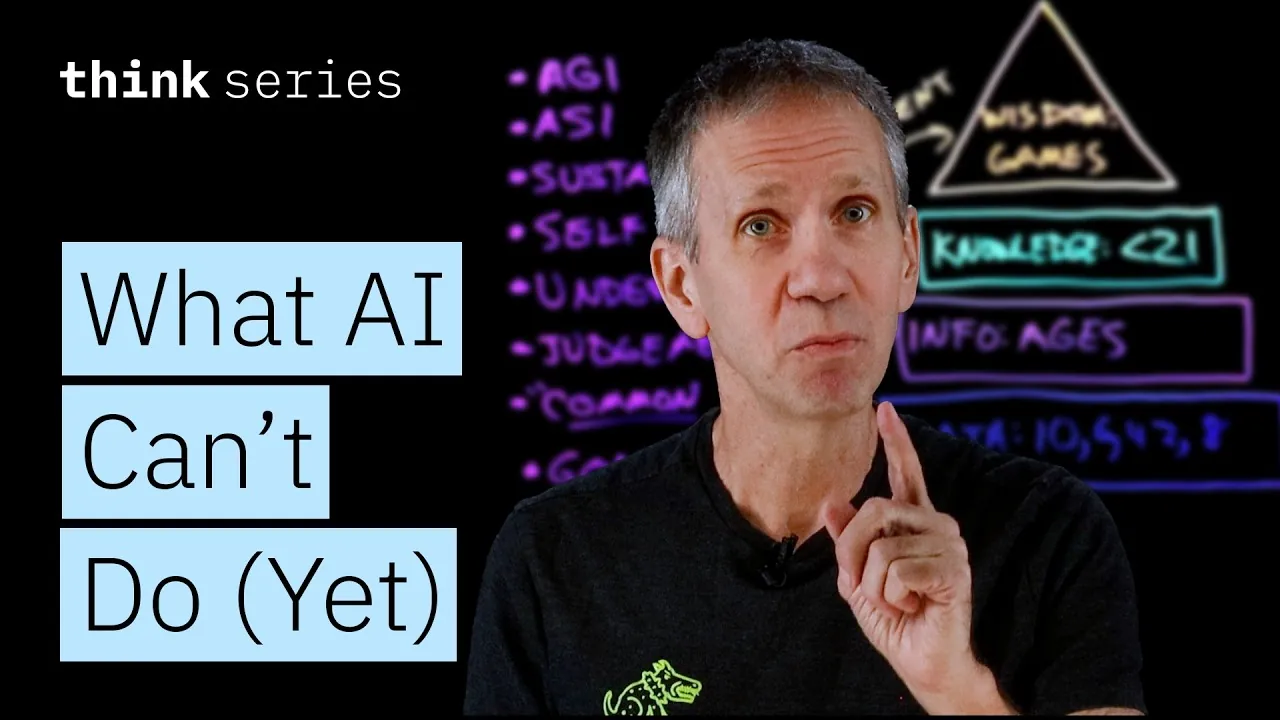
What if the machines we’ve built to mimic human intelligence are, in some ways, as limited as they are extraordinary? While AI dazzles us with its ability to compose symphonies, ace strategy games, and hold eerily human-like conversations, it stumbles in areas we take for granted, like common sense, ethical reasoning, and true adaptability. The rise of tools like generative AI and natural language processing (NLP) has sparked both awe and unease, leaving us to wonder: are we on the brink of creating machines that think like us, or are we merely refining tools that will always need human guidance? The answers lie not just in what AI has achieved, but in the boundaries it has yet to cross.
In this feature, IBM Technology explore the remarkable milestones AI has reached, from its creative ventures in art and literature to its new applications in real-time decision-making. But we’ll also confront its critical limitations, such as the elusive goal of achieving Artificial General Intelligence (AGI) and the ethical dilemmas that arise as machines take on more human-like roles. Along the way, we’ll uncover the delicate balance between human ingenuity and machine efficiency, and why the future of AI may depend less on surpassing human intelligence and more on complementing it. As you read on, consider this: what does it mean for humanity when our most advanced creations still rely on us to define their purpose?
AI Achievements and Challenges
TL;DR Key Takeaways :
- AI has achieved remarkable advancements in areas like reasoning, natural language processing (NLP), generative creativity, real-time perception, and simulated emotional intelligence, showcasing its ability to excel in specialized tasks.
- Key challenges for AI include the development of Artificial General Intelligence (AGI), addressing sustainability concerns, mitigating issues like hallucinations and ethical judgment, and overcoming limitations in common sense reasoning and goal-setting.
- Future directions for AI focus on advancing AGI, creating sustainable and energy-efficient models, addressing ethical and philosophical questions, and enhancing AI’s decision-making capabilities in sensitive fields.
- Human-AI collaboration is essential, with humans providing vision, creativity, and ethical guidance, while AI optimizes execution and delivers efficient solutions, allowing outcomes neither could achieve alone.
- AI’s evolution depends on interdisciplinary efforts to address its limitations, align its development with societal values, and unlock its fantastic potential for addressing global challenges like climate change and healthcare innovation.
AI’s Current Achievements
AI has demonstrated extraordinary capabilities across a wide range of applications, showcasing its ability to process vast datasets, identify patterns, and deliver actionable insights. Some of its most notable accomplishments include:
- Reasoning and Problem-Solving: AI systems such as Deep Blue and AlphaGo have outperformed human experts in complex strategic games, highlighting their advanced decision-making and analytical capabilities.
- Natural Language Processing (NLP): Models like ChatGPT have enabled machines to understand and generate nuanced human language, powering applications such as virtual assistants, real-time translation tools, and automated content creation.
- Generative AI: AI has ventured into creative domains, producing original art, music, and literature. These outputs demonstrate a form of machine creativity that complements and enhances human ingenuity.
- Real-Time Perception: Self-driving cars and robotics use AI for real-time object recognition, navigation, and decision-making, allowing them to operate effectively in dynamic environments.
- Simulated Emotional Intelligence: AI systems are increasingly capable of recognizing and responding to human emotions, improving user experiences in areas such as customer service, mental health support, and personalized healthcare.
While these achievements underscore AI’s ability to excel in specialized tasks, they also highlight its limitations when faced with broader, more complex challenges that require adaptability and contextual understanding.
Ongoing Challenges in AI
Despite its impressive advancements, AI remains constrained by several critical challenges that limit its ability to achieve human-level intelligence and versatility. These challenges include:
- Artificial General Intelligence (AGI): Unlike narrow AI, which excels in specific tasks, AGI aspires to replicate human-like intelligence across all domains. Current AI systems lack the flexibility, adaptability, and contextual understanding required to achieve this milestone.
- Sustainability: The energy consumption of large-scale AI models raises concerns about their environmental impact. Developing energy-efficient systems is crucial for making sure AI’s long-term viability.
- Hallucinations: Generative AI models occasionally produce inaccurate or fabricated outputs, undermining their reliability and trustworthiness in critical applications.
- Self-Awareness and Consciousness: AI lacks an understanding of its own existence, raising philosophical and technical questions about whether true awareness is achievable or even desirable.
- Ethical Judgment: AI struggles with making subjective or moral decisions, particularly in complex, real-world scenarios where ethical considerations are paramount.
- Common Sense Reasoning: AI often fails to apply intuitive, generalized reasoning to unfamiliar situations, limiting its ability to adapt to new contexts effectively.
- Goal Setting: While AI excels at executing predefined tasks, it struggles to independently define, prioritize, and pursue overarching objectives.
- Sensation and Emotions: AI lacks genuine sensory perception and emotional depth, which restricts its ability to replicate or fully understand human experiences.
These challenges highlight the need for ongoing research, innovation, and interdisciplinary collaboration to address AI’s shortcomings and unlock its full potential.
The Limits of AI: Generative AI, NLP, AGI, & What’s Next?

Expand your understanding of Artificial Intelligence (AI) with additional resources from our extensive library of articles.
Future Directions for AI
The future of AI lies in addressing its current limitations while exploring new possibilities that could redefine its role in society. Key areas of focus include:
- Advancing AGI: Researchers are working toward developing AGI systems capable of human-level reasoning, adaptability, and problem-solving across diverse domains.
- Sustainable AI: Efforts to create energy-efficient models and reduce the environmental footprint of AI technologies are essential for their long-term sustainability.
- Ethical and Philosophical Questions: Addressing issues such as consciousness, self-awareness, and moral reasoning will play a pivotal role in shaping the ethical development of AI.
- Enhanced Judgment: Improving AI’s ability to make qualitative and ethical decisions will expand its applications in sensitive fields such as healthcare, law, and governance.
- Human-AI Synergy: Fostering collaboration between humans and AI will enable the creation of systems that combine machine efficiency with human creativity and ethical insight.
These advancements will require a concerted effort from researchers, policymakers, and industry leaders to ensure that AI development aligns with societal values and priorities.
The Role of Human-AI Collaboration
Human-AI collaboration is central to realizing the full potential of artificial intelligence. While AI excels at processing data, optimizing processes, and executing tasks with precision, humans bring creativity, ethical judgment, and purpose to the table. This partnership can be summarized as follows:
- Humans Define “What” and “Why”: You provide the vision, creativity, and ethical considerations that guide AI’s applications toward meaningful and impactful goals.
- AI Determines “How”: AI optimizes the execution of tasks, analyzes complex datasets, and delivers solutions with unparalleled efficiency and accuracy.
By using the complementary strengths of humans and AI, you can achieve outcomes that neither could accomplish independently. This synergy is particularly important in addressing complex global challenges, from climate change to healthcare innovation.
Looking Ahead
AI has achieved extraordinary progress, demonstrating capabilities in reasoning, creativity, and real-time perception that were once unimaginable. However, significant challenges remain, including the pursuit of AGI, the need for sustainable practices, and the resolution of ethical dilemmas. As AI continues to evolve, the collaboration between humans and machines will be critical in overcoming these obstacles and unlocking new possibilities. Through sustained research, innovation, and thoughtful integration into society, AI can become a tool that aligns with human values and aspirations, making sure its fantastic potential is fully realized.
Media Credit: IBM Technology
Filed Under: AI, Technology News, Top News
Latest Geeky Gadgets Deals
Disclosure: Some of our articles include affiliate links. If you buy something through one of these links, Geeky Gadgets may earn an affiliate commission. Learn about our Disclosure Policy.
Credit: Source link