- As of April 2026, tokenized real-world assets had a distributed on-chain value of approximately 27.65 billion distributed across some 710,000 wallet addresses.
- The New York Stock Exchange proposed a rule change to the SEC to allow the exchange to trade tokenized securities on its exchange platform.
- A rising channel pattern drives a short-term recovery momentum in Ethereum price
Over the past seven months, the crypto market has been in a correction trend which saw Bitcoin falling from $126,272 to $59,930 and Ethereum price fell from $4,955 to $1,741. While several crypto sectors mimicked this drawdown, the Tokenized Real-World Assets (RWAs) showed notable resilience and continued to attract money.
Tokenized real-world assets is the process of creating a digital representation of tangible and non-tangible assets like government bonds, real estate, and private credit onto the blockchain. The segment was once viewed as an experiment for an experimental bridge between traditional finance (TradFi) and decentralized finance (DeFi), has now evolved from a niche trend to a core financial infrastructure.
At the heart of this sector, the layer-1 blockchain, Ethereum, stands as the primary settlement layer for institutional-grade finance.
Tokenized Real-World Assets Maintain Momentum in Challenging Markets
By April 2026 on-chain tokenized real-world assets (RWAs) had reached $30.92 billion in distributed value, supported by $437.19 billion in represented underlying assets and held by an approximate of 740,667 addresses. This growth was amidst wider cryptocurrency prices dropping sharply over the last six months, emphasizing selective capital flows to yield-bearing, real-world exposures in risk-off periods.
The sector is dominated by US Treasuries debt with about $15.2 billion tokenized. The amount of private credit is about $6 billion dollars, commodities about $7 billion, and tokenized equities in excess of 1 billion dollars. At approximately 56 percent, Ethereum handles the highest number of settlements.
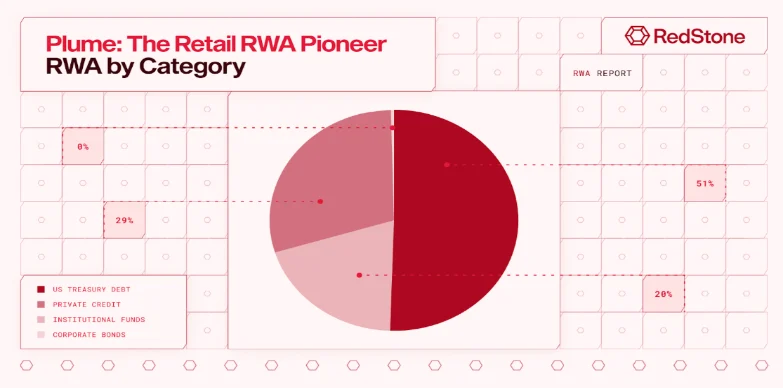
Retail-focused platforms show even heavier concentration, with US Treasury debt often representing over 50% of holdings, followed by private credit and institutional funds.
Long-Term Projections
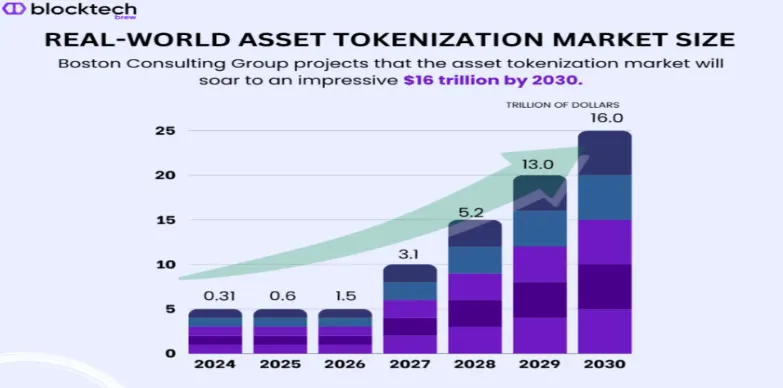
Industry forecasts point to significant scaling. The total market of tokenized real-world assets, according to estimates by the Boston Consulting Group, could grow to 16 trillion in value by 2030. Visual data of 2024-2030 depicts the steady yearly growth: beginning with $0.31 billion in 2024, it rises to $0.6 billion in 2025, to $1.5 billion in 2026, and then sharply accelerates upward, through stratified contributions across asset classes.
Institutional Activity Trends
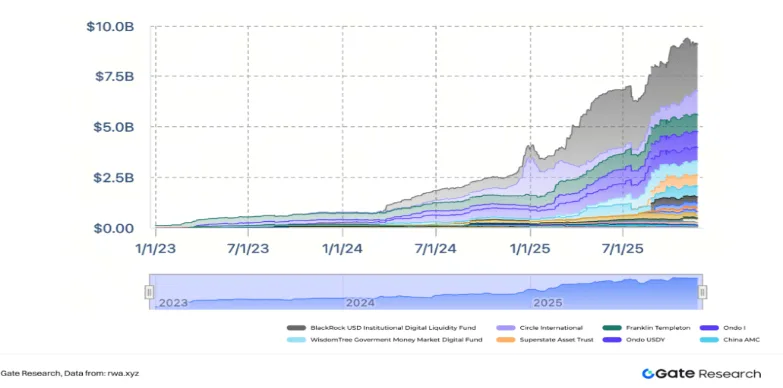
Large financial institutions have established significant presence. BlackRock’s USD Institutional Digital Liquidity Fund and products of Franklin Templeton, Ondo, WisdomTree, and so forth contributed to overlaying growth in total value between the beginning of 2023 and the middle of 2025. The stacked graphical illustrations show that the cumulative inflows are accelerating, at least after late 2024, despite the volatility in the market.
Operational Shifts and Challenges in Operations.
Tokensization transforms traditional assets into blockchain formats, enabling faster settlement, enhanced collateral mobility, and increased distribution. This is not a substitute but an efficiency layer on existing financial products, and attracts participants who focus on yield, the quality of collateral, and optimization of a balance sheet rather than pure price speculation or levearage.
Several constraints persist. Depending on location, individual regions have different regulatory rules, risks unique to custody and counterparty must be carefully managed, and there may be a mismatch of liquidity between tokens and underlying assets. Performance is still susceptible to the changes in interest rates. Growth will not necessarily follow a linear path, and need a sustained higher rates and sustained institutional inflows over any general restoration to high-risk appetite assets.
According to analyst eyezenhour, RWA is a maturing segment in which portions of the crypto infrastructure are becoming more and more supportive of yield generation and collateral roles in addition to traditional markets.
NYSE Advances Tokenized Securities Trading on Traditional Exchange
The New York Stock Exchange has filed a proposed rule change with the U.S. Securities and Exchange Commission to allow trading of tokenized Real-World Assets on its platform. The filing, according to reports on May 3, 2026, aligns with the three-year tokenization pilot program launched by the Depository Trust and Clearing Corporation (DTCC) under a no-action letter by the SEC in December 2025.
In the proposal, tokenized versions of qualified shares and exchange-traded funds (ETFs) would be traded alongside conventional shares. These digital assets should have the same CUSIP identifiers, and ticker symbols with rights and economic benefits as their traditional counterparts. They would be subject to the same order book and subject to the same priority and execution rules. The clearing and settlement would remain on a typical T+1 basis through the DTC.
This is an important advancement in the adoption of blockchain technology into regulated equity markets in the United States, following similar actions by Nasdaq. It indicates an increasing institutional acceptance of tokenization in the existing financial infrastructure without altering current investor protection features and settlement mechanisms.
Ethereum Price Aims to Breakout From Slow-Momentum Channel
Over the past three months, the Ethereum price has projected a slow yet steady recovery within a rising channel pattern above $1,800. Amid the geopolitical tension in the middle east, the ETH price continues to resonate within two parallel channel trendlines which act as dynamic resistance and support.
As the recovery trend gained momentum along with Bitcoin, the Ethereum price reached $2,375, registering its intraday of 2.25%. Consequently, the asset’s market cap is $286.33B, while the 24-hours trading is up 194% to reach $23.19.
Amid steady growth in tokenized real-world assets sector, the Ethereum ETH1.81% price could continue its recovery and surge 7.5% and challenge the channel resistance at $2,550-$2,600. With a 200-day exponential moving average wavering near the same level, a potential breakout from this level significantly boosts buying pressure on ETH, chasing a potential target of $3,000, followed by $3,400.
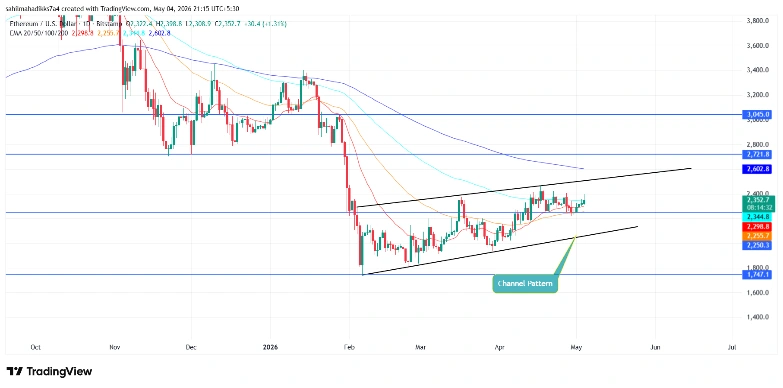
On the contrary, if sellers continue to defend the channel resistance, the coin price could prolong its slow-momentum recovery.
Conclusion
The fast expansion of tokenized real-world assets underscores a significant change in how blockchain technology is being absorbed into international finance. Institutional demand to yield-bearing and/or collateral-backed digital assets continues to grow despite general crypto market weaknesses, with Ethereum remaining at the core of the transformation. The shift of the NYSE to trading tokenized securities is further confirmation of the long-term growth potential of the sector.
Although regulatory uncertainty and liquidity issues persist, RWAs are increasingly becoming more than experiments and more of a foundation layer to modern financial infrastructure, to bridge traditional markets to decentralized systems and to broaden the practical use of blockchain.
Credit: Source link