
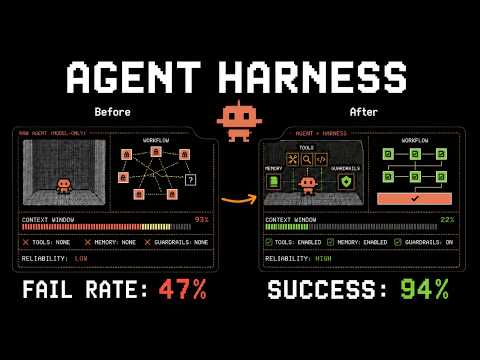
Stanford University’s recent research, conducted in collaboration with Tsinghua University, has revealed a surprising shift in how we evaluate the performance of large language models (LLMs). Rather than focusing solely on the architecture of these models, the study emphasizes the importance of the orchestration layer, or “harness,” which coordinates how the model interacts with external systems like memory and APIs. Prompt Engineering explores this concept, highlighting how a well-designed harness can significantly enhance performance, with some setups achieving up to sixfold improvements. This finding reframes the conversation around AI development, prioritizing adaptability and simplicity in harness design over the complexity of the underlying model.
In this deep dive, you’ll uncover how structured natural language can outperform traditional code-based frameworks in harness design and why overly complex setups often hinder performance. Learn actionable strategies for refining your harness, from modular testing to streamlining redundant components and discover how these improvements can be applied across different models. By the end, you’ll have a clearer understanding of how to optimize AI systems through thoughtful orchestration, making sure they remain efficient and scalable in real-world applications.
Understanding the Harness: The Core of Orchestration
TL;DR Key Takeaways :
- The orchestration layer, or “harness,” has a greater impact on the performance of large language models (LLMs) than the model architecture itself, shifting focus to harness engineering.
- A harness acts as the operational framework for LLMs, allowing efficient communication with external systems and significantly influencing real-world performance.
- Research shows that streamlined, modular and adaptable harness designs outperform overly complex ones, with performance differences of up to sixfold depending on the harness used.
- Harness improvements are transferable across different models, making them scalable and reusable for diverse AI applications.
- Effective harness engineering emphasizes simplification, modular testing and reusability, paving the way for more efficient and adaptable AI systems.
A harness serves as the orchestration layer that transforms an LLM from a static computational model into a dynamic, problem-solving agent. If the LLM can be likened to the CPU of a system, the harness acts as the operating system, coordinating interactions with external components such as memory, tools and APIs. It determines how the model processes input, manages context and executes tasks. In essence, the harness defines the operational framework of the model, making it a critical factor in determining overall performance.
By allowing seamless communication between the LLM and external systems, the harness ensures that the model operates efficiently and effectively. This orchestration layer is not merely a supporting structure but a central component that dictates how well the model performs in real-world applications.
Key Insights: Why Harness Design Matters
The research demonstrated that the same LLM could exhibit vastly different performance levels depending solely on the harness it was paired with. In some scenarios, performance differences were as high as sixfold, underscoring the harness’s critical role. The study uncovered several key findings:
- Harnesses using structured natural language to represent logic consistently outperformed those relying on traditional code-based frameworks.
- Overly complex harnesses with redundant or unnecessary components often hindered performance, while streamlined designs delivered superior results.
- Harness improvements were transferable across different models, demonstrating their scalability and reusability in diverse applications.
These findings highlight the harness as a powerful lever for optimizing AI agent performance, independent of the underlying model’s architecture. This insight encourages developers to prioritize harness design as a critical aspect of AI system development.
Find more information on AI automation by browsing our extensive range of articles, guides and tutorials.
Principles of Effective Harness Engineering
Harness engineering focuses on refining the orchestration layer to enhance efficiency, adaptability and scalability. The study identified several guiding principles that developers can apply to improve harness design:
- Modular Ablation: Isolate and test individual components of the harness to identify which elements contribute most to performance. This targeted approach allows for precise improvements without unnecessary changes.
- Simplification Principle: Streamline the harness by removing outdated or redundant tools. Simplification often leads to greater efficiency, aligning with the “subtraction principle” observed in the study.
- Reusability: Design harnesses with adaptability in mind, making sure they can be applied across multiple models. This reduces redevelopment efforts and maximizes resource efficiency.
By adhering to these principles, developers can create harnesses that are not only efficient but also adaptable to the rapidly evolving landscape of AI technologies.
Actionable Strategies for Developers
For developers aiming to optimize AI agents, the research provides practical strategies to enhance performance through harness design. Before considering a switch to a new model, it is essential to evaluate and refine the existing harness. Key questions to guide this process include:
- Is the context window cluttered with irrelevant or unnecessary information?
- Are there tools or components in the harness that are rarely or never utilized?
- Could verification or search loops be introducing inefficiencies into the system?
- Would structured natural language better express control logic compared to traditional code-based methods?
Simplifying the harness and removing unnecessary complexity often yields better results than adding new features. This approach not only enhances performance but also ensures that the system remains adaptable to future advancements in LLM capabilities.
Broader Implications for AI Development
The findings from Stanford and Tsinghua University have significant implications for the future of AI development. Harness design is emerging as a critical factor in determining the performance of AI agents, potentially outweighing the importance of the underlying model architecture. This shift in focus from architecture to orchestration encourages the development of practical, reusable solutions that prioritize efficiency and scalability.
As the field of AI continues to evolve, simpler and more efficient harnesses are becoming the new standard. By optimizing the orchestration layer, developers can unlock the full potential of LLMs, paving the way for more effective and resource-efficient AI systems. This approach not only accelerates advancements in AI but also ensures that these systems remain accessible and adaptable to a wide range of applications.
The Future of Harness Engineering
The research underscores the fantastic potential of harness engineering in shaping the next generation of AI systems. By focusing on the orchestration layer, developers can significantly enhance the performance of LLMs, regardless of the underlying model. As AI technologies advance, harness design is poised to play an increasingly central role in driving innovation and efficiency.
Harness engineering represents a paradigm shift in AI development, emphasizing the importance of modularity, simplicity and reusability. By adopting these principles, developers can create systems that are not only powerful but also adaptable to the ever-changing demands of the AI landscape. This focus on orchestration over architecture marks a new era in AI, where the potential of LLMs can be fully realized through thoughtful and strategic harness design.
Media Credit: Prompt Engineering
Filed Under: AI, Top News
Disclosure: Some of our articles include affiliate links. If you buy something through one of these links, Geeky Gadgets may earn an affiliate commission. Learn about our Disclosure Policy.
Credit: Source link