Faraday Future’s June 16 event introduced humanoids, quadrupeds, education tools, and an ambitious plan to bring Embodied AI into homes and classrooms.
Faraday Future has spent more than a decade working on intelligent electric vehicles. Now it wants to put that same mix of artificial intelligence, software, and physical engineering into something with legs.
At a June 16, 2026, event held at its new headquarters in El Segundo, California, the company unveiled the first half of what it calls its Full-Form EAI Robot World. The lineup stretches across six product series and includes full-size humanoids, compact humanoids, quadruped robots, educational devices, and products intended for commercial and industrial work.
The launch had no shortage of spectacle. Robots stood across the stage while executives introduced the company’s new education ecosystem, developer tools, partner program, and headline products. Guests included employees, investors, media, educators, and representatives from nearby schools. California State Treasurer Fiona Ma also appeared through a congratulatory video prepared for the event.
Still, the most accessible announcement was standing close to the floor.
The $1,990 Entry Point
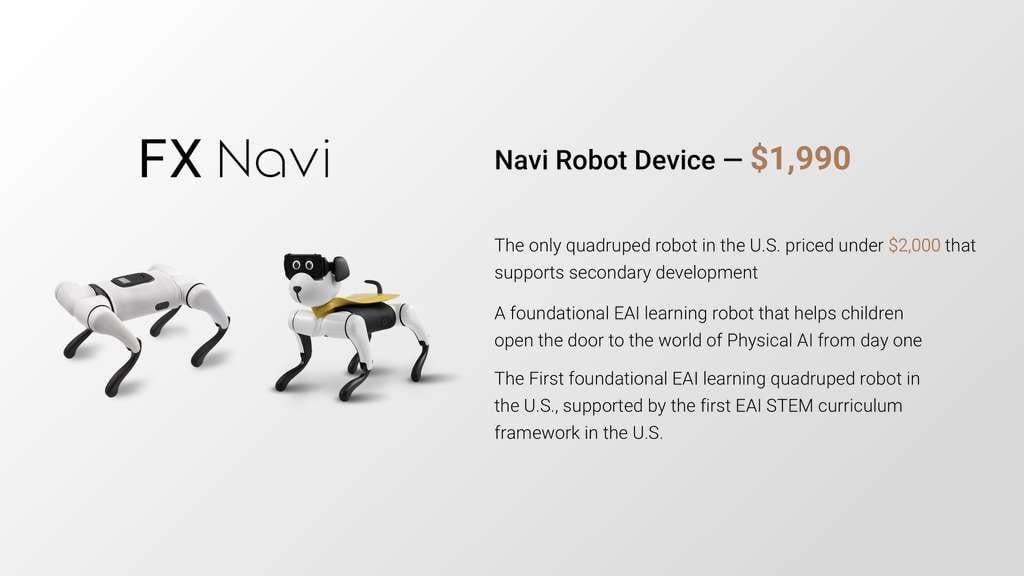
FX Navi is a compact, four-legged robot designed for homes and classrooms. Faraday Future calls it the first foundational Embodied AI learning quadruped in the United States—and says it is the only quadruped robot priced below $2,000 that supports secondary development.
Navi starts at $1,990 and includes 12 joint motors in a roughly 17.6-pound body. It is designed to move across household and classroom surfaces, including carpets, hallways, and door thresholds.
Its most unusual feature may be the way it handles computing. Rather than packing every processing component into the robot, Navi uses a smartphone inserted into its head module. The phone supplies the camera, microphone, and computing power, with support for both iOS and Android.
That approach could lower the barrier to ownership while allowing users to benefit from hardware they already have. It also fits Navi’s larger purpose: giving children a physical device through which they can learn programming, robotics, and AI development.
The robot comes with a visual programming platform, access to an official curriculum, and a Skill Store. Faraday Future has also released the 3D model for Navi’s head module, allowing students to print custom versions and personalize the robot with different shapes, skins, and designs.
For an additional one-time payment of $390, users can unlock a lifetime development and skills package. A separate $490-per-year curriculum option provides nine progressive levels of Embodied AI instruction.
One Brain, Several Bodies
Navi may be the most consumer-ready product in the lineup, but it represents only one piece of Faraday Future’s larger strategy.
The company’s approach is summed up in four words: “one brain, multiple forms.”
The idea is to build a shared Embodied AI foundation that can operate across several types of robots. A quadruped might help children learn coding. A compact humanoid might compete in sports demonstrations. A full-size machine could eventually handle reception, warehouse, factory, or hazardous-environment tasks.
At the top of the new lineup is the All-New Futurist, a full-size humanoid standing approximately 5 feet 8 inches tall and weighing about 121 pounds. It has 31 degrees of freedom, a peak knee torque of 320 newton-meters, and a reported top speed of approximately 11 mph. Its 1,152-Wh dual-battery system is designed to deliver up to six hours of runtime.
The robot also natively supports NVIDIA Sonic’s full-body motion-control system. A higher-performance Futurist Ultra, expected later, will use NVIDIA’s Jetson Thor computing platform.
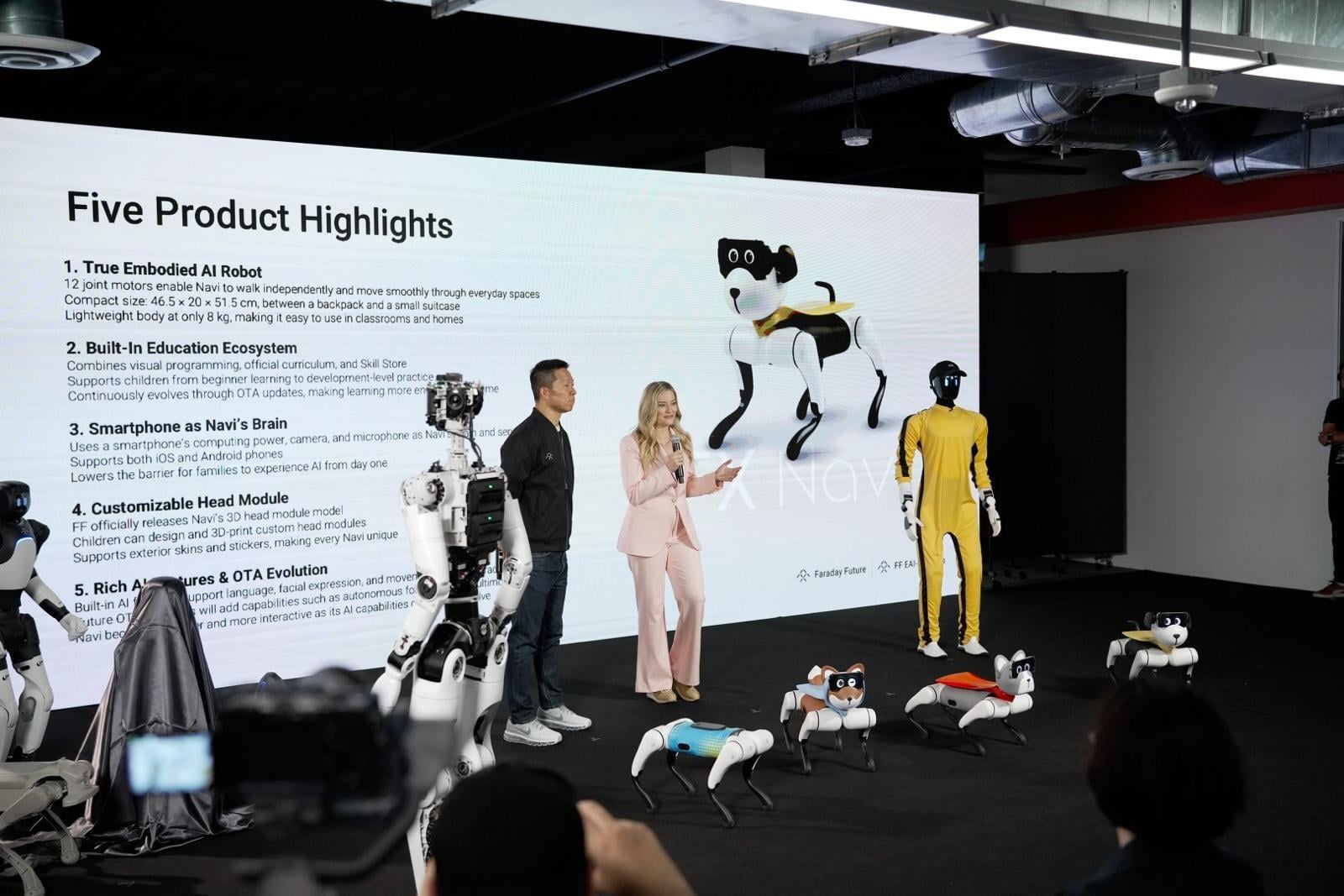
Faraday Future also teased two smaller humanoids: Master Mini, a roughly one-meter robot designed for education and athletic competition, and Nova, a 50-centimeter model intended for education and companionship.
The Bigger Business Bet
The hardware is only half of the plan.
Faraday Future also launched an education-focused ecosystem combining devices, curriculum, developer tools, and an open platform. Its newly released tools include Brain Blocks for visual programming, EAI Soul for designing robot personality and knowledge, Create Studio Beta for generating motion from video, and SDK/API resources for advanced developers.
Students will be able to create robot skills, test them in simulation, deploy them to physical devices, and publish their work through a Youth Agent Skill Store.
That gives the company several possible customers at once: families, schools, universities, developers, content partners, and businesses seeking specialized robots.
Faraday Future is betting that the path to mass-market robotics may begin with education—one robot dog, one classroom, and one young developer at a time.
Filed Under: Technology News
Disclosure: Some of our articles include affiliate links. If you buy something through one of these links, Geeky Gadgets may earn an affiliate commission. Learn about our Disclosure Policy.
Credit: Source link