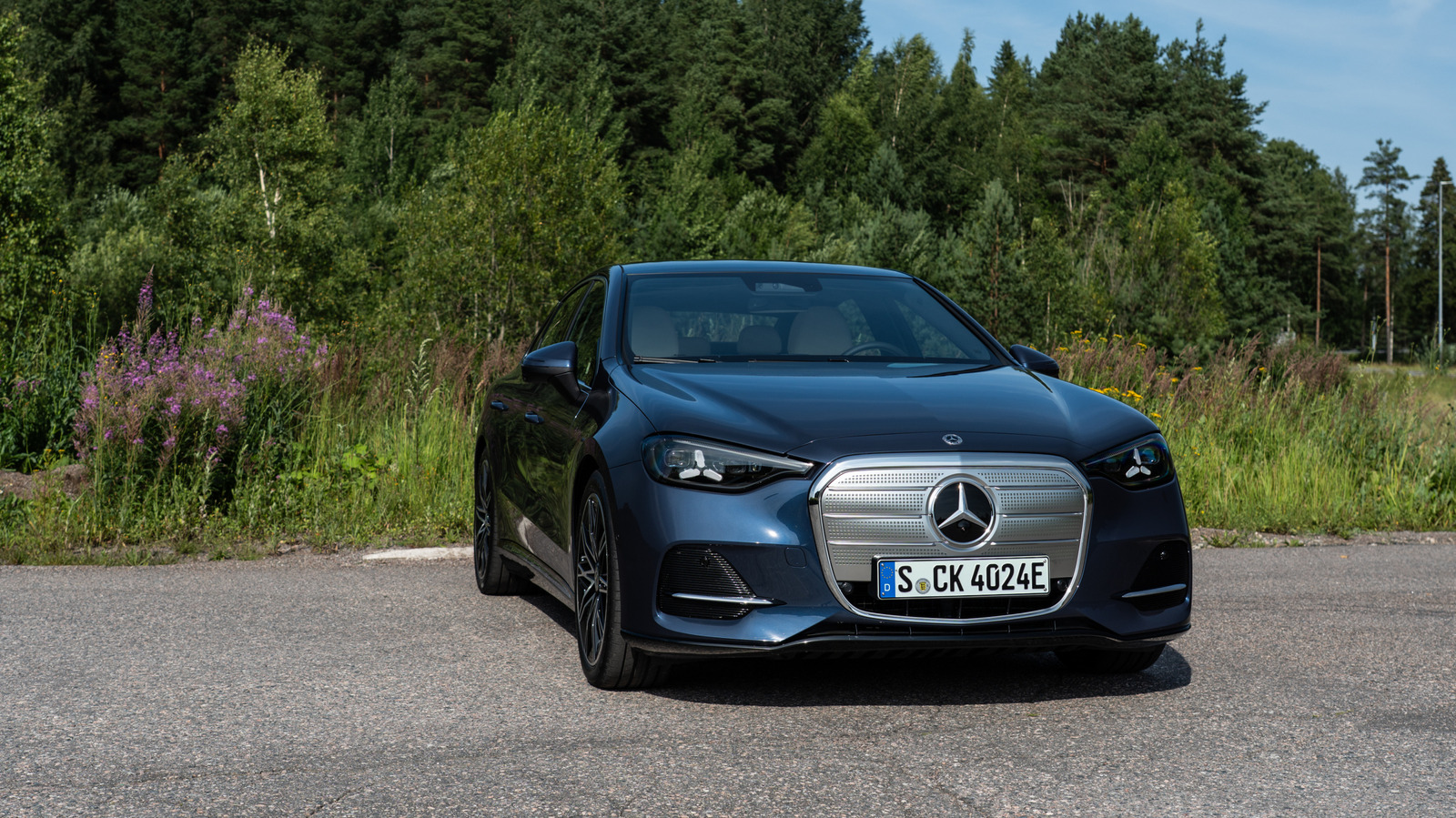
The new C-Class is a brilliant EV with a dashboard that’s a little too in your face.
With a few bright exceptions, the electric car market in the United States isn’t exactly booming at the moment. The sedan segment is likewise soft, with long-time models like the Chevrolet Malibu and Buick Regal being put out to pasture in the past few years.
Mercedes-Benz’s new C-Class Electric, then, is heading into some significant headwinds. As the name implies, it’s battery-powered, and it’s likewise a sedan, following in the footsteps of the brand’s various C-branded models dating back to the early ’90s.
This latest C-Class marks a significant step forward on the technology front, resulting in something with longer range that’s also quicker than Mercedes’ previous EV efforts. For the most part, it’s a resounding success, but after spending two days behind the wheel, a few foibles created a driving experience that left me wanting.
Models and trims
Mercedes-Benz is still shaking out exactly what trims and specifications we’ll see in the US market, but initially there will only be one powertrain to choose from: the dual-motor, all-wheel-drive C 400 4Matic.
This uses a pair of permanent magnet electric motors, one at the front and one at the rear, to deliver 483 horsepower and 590 pound-feet of torque. While middling in the premium EV space, it’s pretty remarkable for a C-Class. That’s well more than the current, performance-oriented AMG C43, which makes 416 horsepower and 369 pound-feet of torque, second only to the top-shelf C63 E Performance.
Mercedes says that’s good enough for the new, electric C-Class to get from zero to 60 mph in 3.9 seconds. It’ll then carry on up to a top speed of 130 miles per hour. You won’t want to be testing either of those figures if range is your priority, though, and by all accounts the new C-Class should be a standout in that regard.
Like the new electric GLC, the C-Class has a 94-kilowatt-hour battery pack down in the floor that charges at a maximum rate of 330 kilowatts. Mercedes says that’s enough to get from 10 to 80 percent in 22 minutes.
Total range is estimated to be 474 miles on the European WLTP score. The American EPA range test is a bit harsher, so expect something closer to 425 miles on a charge once the new C-Class gets certified for US roads.
That, too, is an impressive figure compared to what came before. Mercedes’ closest EV is the EQE sedan, which has up to a 96 kWh battery pack and does 308 miles on a charge in its single-motor configuration.
Look and feel
To maximize range in the EQE sedan, Mercedes-Benz designers prioritized aerodynamic efficiency above all else. The result was an unfortunately formless machine, something that wasn’t ugly, but neither was it particularly compelling.
I wouldn’t say I’m in love with how the new C-Class looks either, but it does at least have some personality to it. Up front is Mercedes’ new signature grille treatment, which can optionally be festooned with 1,050 lights, ensuring that you’ll make quite an impression during nocturnal arrivals.
For the most part, the new C-Class is a compelling-looking machine on the inside. The seats are comfortable and striking, and you have your choice of numerous materials for both upholstery and dashboard detailing. Mercedes is even offering a fully vegan alternative for those who prefer their cars to be cruelty-free, an option I wholeheartedly support.
But it’s the most visible aspect of the interior that is my least favorite part of the whole car. That’s the 39.1-inch Hyperscreen display that spans basically the entire dashboard with a single, LED-backlit panel.
It’s not the display itself that’s the problem. The image quality is spectacular, and it really does make for a visually stunning experience. It’s the positioning of the thing that I hate. Like on the CLA, Mercedes-Benz’s designers positioned the display almost vertically. This makes it nice and easy to reach out and touch, but having such a massive, vertical display positioned so closely to you looks and feels awkward.
Between that and the high center tunnel between the seats, sitting up front feels a bit claustrophobic. That’s despite the abundance of head and legroom.
Tech overview
If nothing else, having all those pixels enables a compelling digital experience. On the far right, the passenger has their own interface where they can queue up videos from YouTube or engage in a few underwhelming and extremely dated games. (Angry Birds, anyone?)
The rest of the experience is more modern, including a visually slick and responsive navigation interface. You can get up to 19 speakers from the Burmester sound system with Dolby Atmos support, and there’s even Microsoft Teams in the dash if you really must make your commute miserable.
Vehicle settings are just a few taps away and, if you can’t find something, there’s an AI-powered voice agent to help.Three, actually. Mercedes has aggregated the agentic might of ChatGPT, Google and Microsoft, doling out your voice prompt to the appropriate LLM based on your request. This creates occasionally laggy responses, as some requests for restaurant reviews and menu items took quite a long time.
More annoyingly, the AI had a tendency to butt in unwanted. I was conversing with my passenger about a certain, rather frustrating topic, and out of the blue, Mercedes AI chimed in with something to the effect of: “It sounds like you really don’t like [so-and-so].” It then tried to provide some helpful context to the situation that was, of course, entirely unhelpful.Thankfully, this sort of unprompted response can be disabled, but it was a somewhat disconcerting reminder that the car is always listening.
On the safety side of the technology equation, the C-Class is loaded with radar, vision and acoustic sensors. Every model has the full suite, and all have features like adaptive cruise control. However, you’ll need to pay extra to unlock advanced driver assistance features, like the upcoming MB.Drive Assist Pro, which will enable the car to automatically follow navigation prompts and even stop at intersections.
Drive time
My time in the C-Class started in Helsinki and then extended out into the countryside. Finland is a lovely place filled with lovely roads. But with some of the slowest speed limits in the world, paired with some of the harshest speeding fines, it’s not exactly a great place to let a car stretch its legs.
It was, though, a perfect opportunity for letting the C-Class do what most will be tasked with in real life: cruising at moderate speeds. The C 400 I drove was extremely good at that. In its softest setting, the optional adaptive suspension provided a wonderfully smooth ride. Ride quality is top-notch.
While I was able to sample the 483 horsepower on a few highway on-ramps, Mercedes thankfully secured a little track time for me to try out the new C-Class’s handling. In Sport mode, the suspension gets a bit more serious, and the rear-steering system adds enough agility to create a surprisingly engaging driving experience. The new C-Class is no sports car, but if you’re the sort who takes the twisty way home after a long day in the office, it’s up to the task.
Wrap-up
The new C-Class Electric is extremely pleasant to drive and, with all that digital horsepower paired with a stellar sound system, a generally pleasant place from which to drive it. My biggest complaint here is that giant slab of a dashboard, though the intrusive AI left me feeling a bit uneasy too.
If you don’t mind those caveats, the C-Class should not disappoint when it hits American dealers in the first half of 2027. But there’s still the big question of cost, which is perhaps the most important factor for success or failure. If Mercedes can stick the landing, the new C-Class should be good enough to buck the current four-door EV odds.
Credit: Source link