
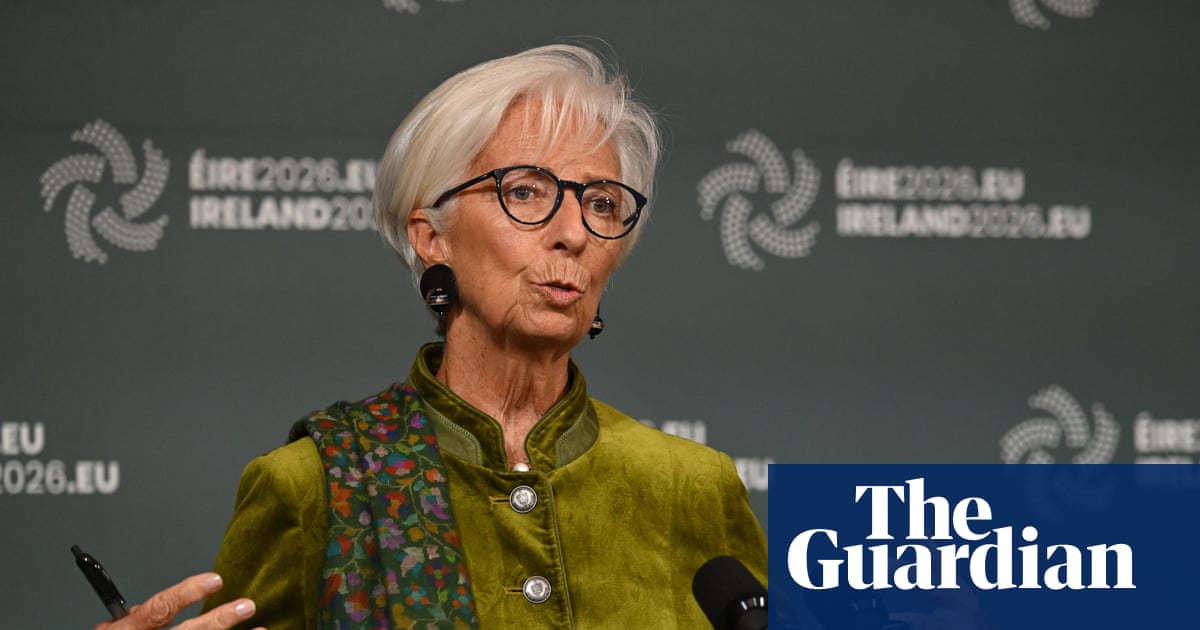
Europe’s dilemma over AI was rendered in stark terms this week. The head of the continent’s central bank, Christine Lagarde, said Europeans have two options: shun the technology and lose out on growth; or embrace it and become dependent on tools developed by the US and China.
The great debate over AI safety that has erupted in recent days threatens to make the choice moot. If the worst scenarios come to bear – and experts have differing views on this – then the technology will impact the continent regardless.
Europe has largely been absent from the highest levels of that debate, a result of the continent’s longstanding inability to produce a Silicon Valley-scale titan like Apple, Google or newcomer OpenAI. While it is a powerhouse in regulation, much to the White House’s chagrin, its lack of an Anthropic or Nvidia-sized frontrunner in the AI race has diminished its voice in the safety debate.
Ursula von der Leyen, a powerful political figure on the continent as president of the European Commission, the EU’s executive arm, addressed the issue this week by saying she will “invite the main frontier labs for a discussion on how we can support ongoing industry efforts to pace the frontier”.
Her remarks gained nowhere as much traction as Donald Trump and China’s dismissal of a slowdown. Without the support of Washington or Beijing, any sort of pacing is impossible – with our without Europe’s input.
Lagarde’s speech on Monday underlined the continent’s relative weakness. She asserted that Europe must develop its own AI technology and build more datacentres in order to nullify the threat of being cut off by the US or China.
If Europe invests in its own AI tech, said Lagarde, “the threat of being cut off loses its force.” Self-sufficiency would also give Europe a chance to develop its own answer to the AI safety crisis.
Margrethe Vestager, who clashed with the US tech industry as the EU’s former competition commissioner, co-authored a report this week – A Transformative AI Strategy for Europe – that echoed Lagarde’s warning. AI threatens to accelerate a development already affecting Europe, where citizens “are already bearing the economic and social consequences of decisions taken elsewhere”, she says.
Solutions to this, according to the report, include building more datacentres – the central nervous systems of AI – and also to ensure the continent is resilient enough to withstand “AI crises” like a powerful model slipping out of control.
Vestager said that Europe does have a voice in the safety debate through its EU AI Act, the rare piece of AI legislation that sets out requirements for developers of “high-risk” AI systems to report safety incidents and address risks like a cutting-edge model evading control.
But she adds: “Europe must … build its own AI to strengthen the ecosystem, retain talent, and inspire innovation.”
Vestager acknowledges that if there is an existential threat, it requires a global solution; one that does not hand power to the US and China. And that requires a different kind of supranational body.
“As for existential threats to humanity, we must first assess the actual level of threat – then act with urgency. The UN general assembly is an opportunity to address this. It is vital to move beyond the US-China rivalry narrative. There must be space for humanity between the egos of leaders like President Xi and President Trump.”
Frederike Kaltheuner, an adviser to the AI Now Institute, a research body, says that Europe is dependent on US technology in ways that will be hard to undo, from search engines to chips to datacentres. But the narrative that Europe is grievously behind in the race depends on a particular view of artificial intelligence aggressively promoted by American tech bosses.
after newsletter promotion
Because of their doomsday warnings, “we are exclusively talking about AI in a very narrow, specific kind of way – namely, the idea that there is such a thing as the AI frontier, which is getting better and better, and that access to the frontier is the most important thing that Europe needs for its security and economy.”
The reality of the market points at something else, she says: many companies are not adopting so-called “frontier models” – like ChatGPT and Anthropic – because of high costs and fears over what might happen to their data.
If this trend continues, Europe may not be so terribly positioned: the EU AI Act has a number of pragmatic measures which address how consumers might encounter AI on a day-to-day basis, legislating over matters such as labelling AI content, and the use of AI in medicine and hiring.
“Europe has a competitiveness problem, that’s true,” says Itxaso Dominguez de Olazabal, a policy adviser at EDRI, a European digital rights organisation. But US tech boosters are “blaming it on laws and protections, and have promised that deregulation will make European companies more competitive … in a race to the bottom to see if we can catch big tech”.
Nonetheless, the EU AI act is not viewed as model legislation for other countries or a vehicle for a global slowdown. Georgina Kon, a partner at law firm Linklaters, says the act is unlikely to be adopted as a global benchmark for several reasons, including criticisms of the heavy compliance burden, which has led to delays in parts of the act becoming active, and a narrow territorial focus on Europe. Those criticisms have also meant that lawmakers elsewhere have looked to differentiate their approach to AI legislation from the EU’s.
“The EU AI Act is not something that everybody else in the world feels constrained by, although many tech companies will of course want to sell to the EU,” she says.
Big tech still has a vast customer base in Europe. Kaltheuner worries that the doomsday narratives will push Europe towards dependency, encouraging it to adopt US AI models across the economy out of ill-defined fears over being left behind.
“There’s a vision of the future where Europe’s economy, its public sector, its education system runs on models and on infrastructure that is controlled by a very small number of companies that happen to be also in the US. This would be a sovereignty problem.”