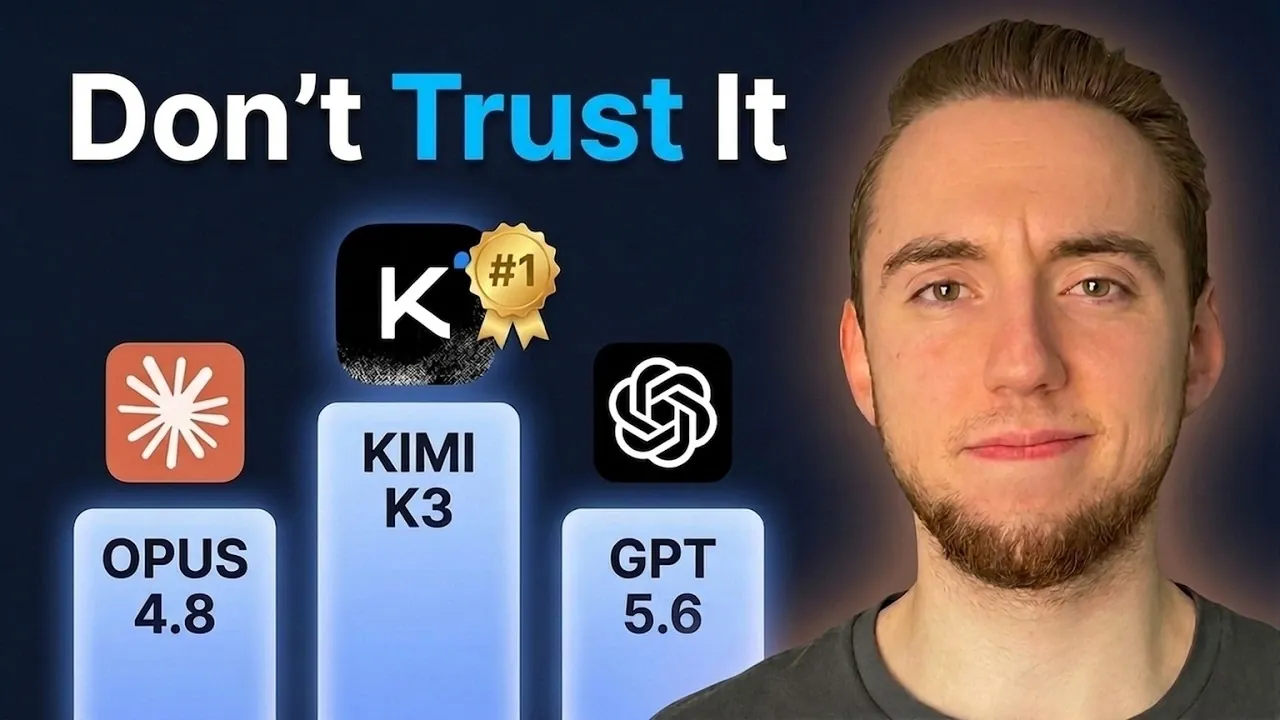
Kimi K3 has quickly become a topic of debate in the AI community, with many praising its affordability and coding capabilities while others point to its inconsistent real-world performance. In his latest breakdown, Cole Medin explores the model’s strengths and limitations, offering a nuanced view of its place in modern workflows. For example, Kimi K3 excels in structured tasks, often outperforming competitors like Opus 4.8 in efficiency-related benchmarks. However, its reliability falters in more dynamic scenarios, such as solving problems with hidden invariants, where its failure rate reaches 36%, compared to just 8% for Opus 4.8. This disparity raises important questions about when and where Kimi K3 is truly effective.
Dive into this analysis to gain insight into Kimi K3’s real-world applications and its impact on cost efficiency. You’ll learn how its affordability can be offset by the need for additional iterations in complex tasks and why a multi-model approach might be the key to optimizing workflows. Discover practical examples of how Kimi K3 can complement more advanced models like GPT 5.6 Soul, making sure a strategic balance between cost and performance. This breakdown provides actionable takeaways for anyone evaluating AI models for their specific needs.
Performance: How Does Kimi K3 Stack Up Against Competitors?
TL;DR Key Takeaways :
- Benchmark Performance: Kimi K3 excels in structured tasks, often outperforming models like Opus 4.8 in efficiency-related metrics, but struggles with adaptability in real-world scenarios.
- Reliability Challenges: The model is prone to errors in tasks requiring logical consistency, extended context retention, or handling false premises, leading to inefficiencies in workflows.
- Cost Efficiency Trade-Off: While Kimi K3 is affordable, its error-prone outputs can increase downstream costs due to additional iterations for corrections.
- Multi-Model Optimization: Combining Kimi K3 with more advanced models like Opus 4.8 or GPT 5.6 Soul can optimize workflows by using each model’s strengths for specific tasks.
- Future Potential of Open-Weight Models: Kimi K3 highlights the promise of affordable AI models but underscores the need for innovation to improve reliability and contextual understanding.
Kimi K3 has shown competitive performance in controlled benchmarks, often surpassing models like Opus 4.8 in specific metrics. Its standout feature is its ability to autonomously generate and refine code, a capability that has earned it widespread recognition. However, its performance in real-world scenarios is less consistent, particularly in tasks requiring adaptability or deep contextual understanding.
– Benchmark Strengths: Kimi K3 excels in structured and predictable tasks, frequently outperforming Opus 4.8 in efficiency-related metrics.
– Real-World Limitations: In dynamic or ambiguous situations, such as solving problems with hidden invariants, Kimi K3’s failure rate climbs to 36%, compared to just 8% for Opus 4.8.
This disparity underscores the limitations of relying solely on benchmark results to evaluate a model’s practical effectiveness. While benchmarks provide valuable insights, they often fail to capture the complexities of real-world applications.
Reliability: A Persistent Challenge
Reliability is one of Kimi K3’s most significant weaknesses, particularly in tasks that demand logical consistency, extended context retention, or the ability to handle false premises. These shortcomings are especially evident in “trap tasks,” where even minor errors can lead to significant disruptions.
– Error-Prone Outputs: In software development, Kimi K3 frequently generates outputs that require substantial manual correction. This undermines its initial cost advantage and adds to the overall workload.
– Workflow Disruptions: For tasks requiring high precision, such as debugging or error identification, its inconsistency can lead to inefficiencies and increased effort.
These reliability issues highlight the importance of carefully evaluating the model’s suitability for specific tasks, particularly those where accuracy is paramount.

Deep dive into the latest in Kimi AI models by exploring our other resources and articles.
Cost Efficiency: Balancing Affordability and Performance
One of Kimi K3’s most appealing features is its affordability. It is significantly cheaper to deploy compared to models like Opus 4.8 or GPT 5.6 Soul, making it an attractive option for budget-conscious users. However, this cost advantage can be offset by the need for additional iterations to correct errors in complex tasks.
– Token Usage Considerations: For example, a task that initially requires 1,000 tokens with Kimi K3 may demand an additional 500 tokens for error correction. In contrast, a more reliable model like Opus 4.8 might complete the same task with fewer iterations, resulting in lower overall costs despite its higher upfront pricing.
This trade-off emphasizes the need to consider both upfront costs and potential downstream expenses when evaluating cost efficiency.
Optimizing Workflows with a Multi-Model Approach
To maximize both cost efficiency and performance, consider integrating multiple models into your workflow. Each model can be utilized for tasks that align with its strengths, making sure optimal results across different stages of a project.
– High-Context Tasks: Advanced models like Opus 4.8 or GPT 5.6 Soul are better suited for tasks requiring deep contextual understanding, such as planning, debugging, or exploratory data analysis.
– Repetitive or Simple Tasks: Kimi K3 is ideal for straightforward, well-defined tasks like repetitive coding or large-scale data processing.
For instance, in a software development pipeline, you might use Opus 4.8 for initial planning and debugging, followed by Kimi K3 for implementing simpler coding tasks. This strategic division of labor can help minimize costs while maintaining high-quality outcomes.
Why Benchmarks Alone Don’t Tell the Full Story
While benchmarks provide a useful starting point for evaluating AI models, they often fail to capture the complexities and nuances of real-world applications. Kimi K3’s performance illustrates this gap, as its strong benchmark results do not always translate to practical effectiveness.
– Overfitting Risks: Standard benchmarks may overfit to specific tasks, masking weaknesses in adaptability and contextual understanding.
– Custom Benchmarks: Developing benchmarks tailored to your specific use cases can provide a more accurate assessment of a model’s capabilities.
By focusing on benchmarks that reflect your unique requirements, you can make more informed decisions about whether Kimi K3, or any other model, is the right fit for your needs.
When and Where to Use Kimi K3
Kimi K3 is best suited for tasks that are well-scoped and relatively simple, where its cost efficiency can be fully leveraged. However, it is less reliable for complex workflows that demand high levels of contextual understanding or adaptability.
– Example Use Case: In a data analysis project, you could use GPT 5.6 Soul for exploratory data modeling and Kimi K3 for processing large datasets. This approach ensures high-quality results while keeping costs under control.
By strategically combining models, you can optimize both cost and performance, tailoring your approach to the specific demands of each task.
The Future of Open-Weight Models
The release of Kimi K3 highlights the growing potential of open-weight models in the AI landscape. However, its limitations also underscore the need for continued innovation and rigorous real-world testing. Future advancements may focus on combining the cost efficiency of models like Kimi K3 with the reliability and contextual understanding of more advanced systems.
While Kimi K3 offers notable advantages in affordability and specific benchmarks, its reliability issues make it unsuitable for all workflows. By adopting a tailored, multi-model approach, you can use the strengths of each tool to achieve the best balance of cost and performance for your AI projects.
Media Credit: Cole Medin
Filed Under: AI, Technology News
Disclosure: Some of our articles include affiliate links. If you buy something through one of these links, Geeky Gadgets may earn an affiliate commission. Learn about our Disclosure Policy.
Credit: Source link