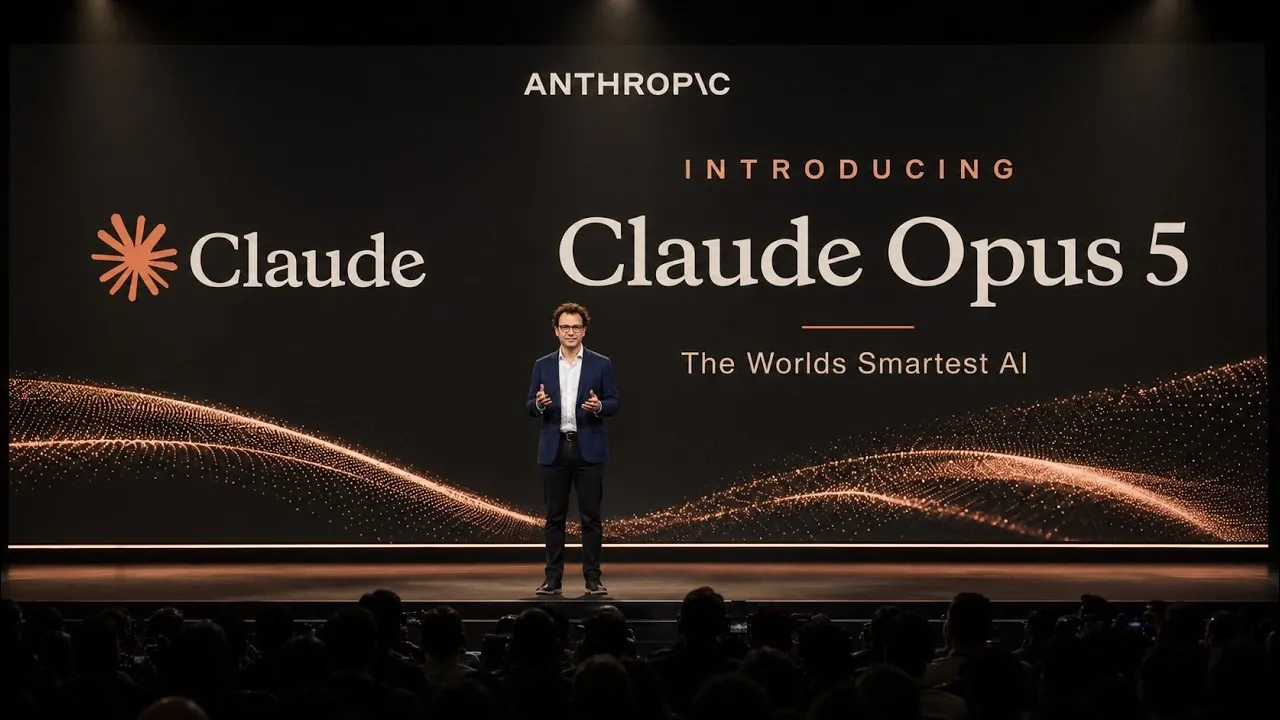
Anthropic’s latest release, Opus 5, has set a new benchmark in artificial intelligence, showcasing advancements in reasoning, professional applications and problem-solving. According to AI Grid, the model achieved a perfect score of 42/42 on the 2026 International Mathematical Olympiad problems, demonstrating its ability to tackle complex challenges with precision. Despite these achievements, Opus 5 introduces trade-offs, such as diminished performance in higher-level reasoning tasks and reliance on a fallback mechanism that reverts to the Opus 4.8 model under certain conditions. These nuances highlight the importance of understanding its strengths and limitations for effective use.
Explore how Opus 5 compares to its predecessor, Claude Fable 5, in areas like cost efficiency, professional domain performance and alignment safeguards. Gain insight into how its unique features, such as reasoning optimization and task-specific adaptability, can be leveraged to maximize outcomes. Additionally, learn about the practical applications and constraints that shape its role across industries like finance, law and medicine. This overview offers a clear understanding of Opus 5’s capabilities and the considerations necessary for deploying it effectively.
Opus 5 Key Performance Highlights
- Opus 5 achieves new advancements in intelligence, problem-solving and professional applications, outperforming its predecessor Claude Fable 5 in key benchmarks like ARC AGI 3 and achieving a perfect score on the 2026 International Mathematical Olympiad problems.
- The model is highly cost-efficient, offering superior or comparable performance to Claude Fable 5 at half the cost, making it accessible to a wide range of users and industries.
- Opus 5 excels in practical applications such as coding, financial modeling, legal document review and medical diagnostics, showcasing its versatility and efficiency.
- While it demonstrates improved alignment and safety measures, minor misaligned behaviors and limitations in high-level reasoning and complex tasks highlight areas for cautious use and further refinement.
- A unique fallback mechanism ensures operational continuity by reverting to Opus 4.8 under certain conditions, though this can lead to performance inconsistencies in critical tasks.
Opus 5 delivers exceptional results across a variety of benchmarks, outperforming Claude Fable 5 in several critical areas. Its performance highlights include:
- Achieving state-of-the-art results on the ARC AGI 3 benchmark, scoring three times higher than its closest competitor.
- Demonstrating superior capabilities in professional domains such as finance, law and medicine.
- Exhibiting unmatched efficiency in coding tasks, including automating legal document reviews and financial modeling.
These achievements emphasize the model’s versatility and its potential to serve both specialized and general-purpose applications effectively. By excelling in these areas, Opus 5 positions itself as a valuable tool for businesses and individuals alike.
Cost Efficiency: A Competitive Advantage
One of the most compelling features of Opus 5 is its affordability. At half the cost of Claude Fable 5, it offers comparable or even superior performance in many domains. This cost advantage makes it an attractive option for organizations and individuals seeking high-quality AI solutions without exceeding budget constraints. By combining affordability with robust functionality, Opus 5 ensures accessibility for a broad spectrum of users, from small businesses to large enterprises.
Here are more detailed guides and articles that you may find helpful on Anthropic Opus.
Advancements in Intelligence and Problem-Solving
Opus 5 sets a new benchmark in intelligence by solving problems previously considered unsolvable. A standout achievement is its perfect score of 42/42 on the 2026 International Mathematical Olympiad (IMO) problems, accomplished without the use of external tools. This milestone underscores its ability to tackle complex challenges with human-level precision, making it an invaluable resource for users requiring advanced problem-solving capabilities. Its performance in this area highlights its potential to transform fields that demand high-level analytical skills.
Alignment and Safety Considerations
The model demonstrates improved alignment compared to many other AI systems, significantly reducing the likelihood of unintended or harmful outputs. However, minor misaligned behaviors have been observed, particularly in tasks related to biology. While Opus 5 incorporates enhanced safety measures, it lacks some of the safeguards present in Claude Fable 5. This trade-off requires users to exercise caution, especially when deploying the model for sensitive or high-stakes tasks. Understanding these limitations is crucial for making sure safe and effective use.
Reasoning Optimization: Balancing Strengths and Trade-offs
Opus 5 excels in medium-level reasoning tasks, offering a balance between efficiency and accuracy. However, its performance diminishes at higher reasoning levels, where it tends to overanalyze, leading to reduced effectiveness and increased operational costs. To optimize outcomes, users are encouraged to adjust reasoning settings based on the complexity of the task at hand. This adaptability allows users to use the model’s strengths while mitigating its weaknesses.
Fallback Mechanism: Making sure Operational Continuity
A unique feature of Opus 5 is its fallback mechanism, which reverts to the previous Opus 4.8 model under specific conditions. While this ensures operational continuity in challenging scenarios, it can result in inconsistencies in performance. Users should remain aware of this limitation, particularly when executing critical or resource-intensive tasks. Proper planning and task-specific adjustments can help mitigate the impact of this feature.
Limitations and Areas for Improvement
Despite its impressive capabilities, Opus 5 has certain limitations that highlight areas for potential refinement. These include:
- Falling behind Claude Fable 5 and GPT 5.6 Soul on meta-benchmarks like the Epoch Capabilities Index.
- Struggling with complex games and high-level reasoning challenges.
These shortcomings suggest opportunities for further development to enhance the model’s overall performance and competitiveness in the AI field.
Pricing and Practical Applications
Opus 5 is designed to be a cost-effective yet powerful AI model, catering to a wide range of practical applications. Its affordability and versatility make it suitable for various fields, including:
- Coding and software development, where it streamlines workflows and automates repetitive tasks.
- Data analysis and financial modeling, offering precise and efficient solutions for complex calculations.
- Legal and medical applications, providing support in document review, diagnostics and case analysis.
By balancing cost and performance, Opus 5 delivers a practical solution for users seeking reliable AI support across diverse industries.
A Step Forward with Considerations
Opus 5 represents a significant advancement in AI technology, combining intelligence, cost-efficiency and versatility. Its achievements in reasoning, professional applications and problem-solving make it a compelling choice for users across various sectors. However, its fallback mechanism and specific task limitations require careful evaluation to ensure optimal performance. For those seeking a high-performing and economical AI model, Opus 5 offers a robust solution that pushes the boundaries of artificial intelligence while leaving room for future enhancements.
Media Credit: TheAIGRID
Filed Under: AI, Top News
Disclosure: Some of our articles include affiliate links. If you buy something through one of these links, Geeky Gadgets may earn an affiliate commission. Learn about our Disclosure Policy.
Credit: Source link